



Miracles have been made in Tibet Autonomous Region, known as the "roof of the world." The number of people living in poverty has fallen from 800,000 in 2013 to 150,000 last year.
This year, the region aims to eliminate absolute poverty that has been looming over the region for thousands of years.
LHASA, Oct. 12 (Xinhua) -- Known as the "roof of the world," Tibet Autonomous Region is known for its picturesque plateau landscapes and splendid ethnic cultures. It is also one of the main grounds in China's nationwide campaign against poverty.
Miracles have been made in the area. The number of people living in poverty has fallen from 800,000 in 2013 to 150,000 last year. This year, Tibet aims to eliminate absolute poverty that has been looming over the region for thousands of years.
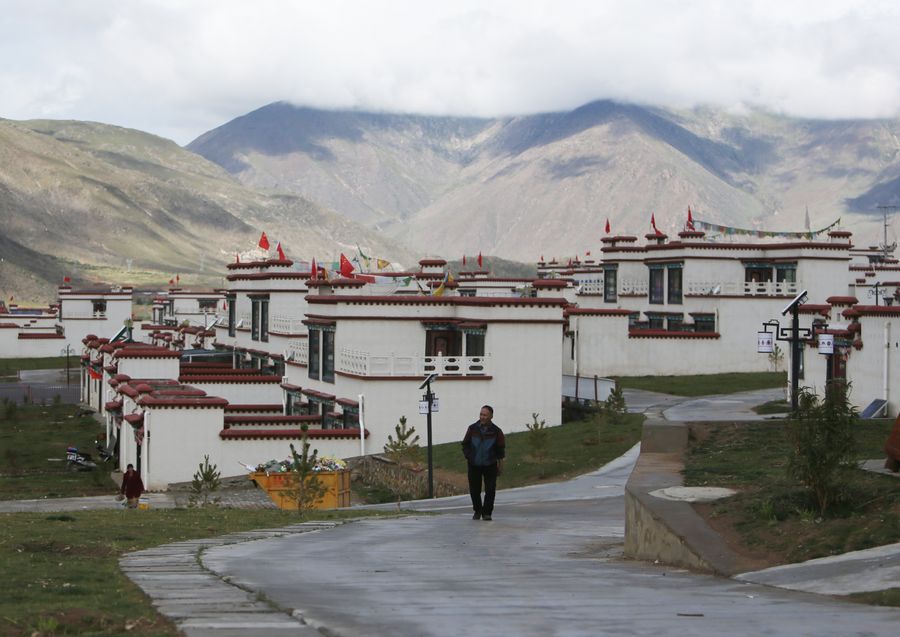
A man walks at a relocation area for Rongma Town villagers in Lhasa, Sept. 22, 2019. (Xinhua/Zhang Yudong)
RELOCATE FOR A BETTER LIFE
In Tibet, the special geographical environment is one of the main causes of poverty in many areas. Extremely high altitudes, snow-capped mountains and barren land are standing in the way of people's efforts to shake off poverty. Some places are almost naturally isolated from the outside world.
Relocation has been a major measure for the region to alleviate poverty.
Renqin, 38, was once a herdsman living in Rongma town of Nagqu, located some 5,000 meters above sea level. The area is plagued by a lack of oxygen and vegetation. In the past, local herdsmen migrated regularly to wherever water and grass were available.
As part of a governmental project to relocate people from harsh living conditions and ecologically fragile areas, 262 households of herders in Rongma were moved to newly-built houses in Gachong Village in Lhasa's Doilungdeqen County in June last year.
"Life is so much better now. We have tap water, stable electricity supply and home appliances such as refrigerators and washing machines. This was unimaginable in the past," he said, looking proudly around at his new house.
Back in his Nagqu hometown, people fetched water from wells and had a limited supply of electricity with some simple solar panels equipped on their houses.
More to Renqin's satisfaction, his five children now enjoy better access to education and hospitals.
The local government is building a cattle raising collective enterprise and rural hostels, which will offer abundant job opportunities for the relocated herdsmen like Renqin.
China plans to invest 19.78 billion yuan (2.79 billion U.S. dollars) in a relocation program to build 60,931 houses in around 970 settlements for 266,000 poverty-stricken residents in Tibet.
Some 248,000 people in Tibet have moved into 910 new settlements by the end of August, according to the region's poverty-relief headquarters.
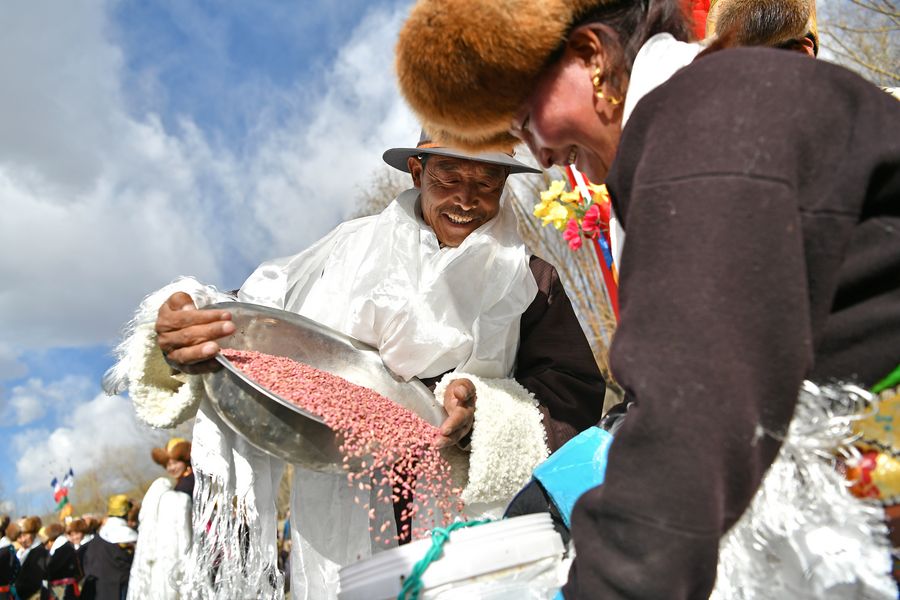
Residents attend a spring plowing ceremony in Shannan City, southwest China's Tibet Autonomous Region, March 16, 2019. (Xinhua/Li Xin)
SUPPORT FROM OUTSIDE
The township of Lunang in the southeastern part of Tibet has become a booming tourist destination for those who want to experience the challenge of climbing a plateau while still enjoying enough oxygen.
Last year, over 1 million tourists visited the small township in Nyingchi, which is at a lower altitude than the average of Tibet. Lunang is described as an oxygen bar with alpine beauty comparable to that of Switzerland.
In 2017, Guangdong, one of the most developed provinces in China, bankrolled an international tourism development project in Lunang. Local residents like Lhapa Tsering, 42, were sent to receive training on providing quality dining and accommodation services to visitors.
In 2018, the township made 70 million yuan in revenue from tourism.

Photo taken on June 27, 2019 shows a scene of an epic drama "Princess Wencheng" in Lhasa. (Xinhua/Jigme Dorje)
Lhapa Tsering made about half a million yuan last year. "Life has become as good as it can be," he said.
The leapfrog development of ecological tourism in Lunang is both a result and an example of "pairing-up support for Tibet" from provincial-level regions and centrally-administered enterprises.
With the pairing-up support policy, which started in 1994, certain provinces, municipalities and state-owned enterprises are designated to render assistance to Tibet.
Statistics show that last year, 17 provincial-level regions and 16 centrally-administered companies invested over 9 billion yuan into the region. Close to 70 percent of the funds went to 44 counties with a large number of the population living under the poverty line of the per capita annual income of 2,300 yuan.
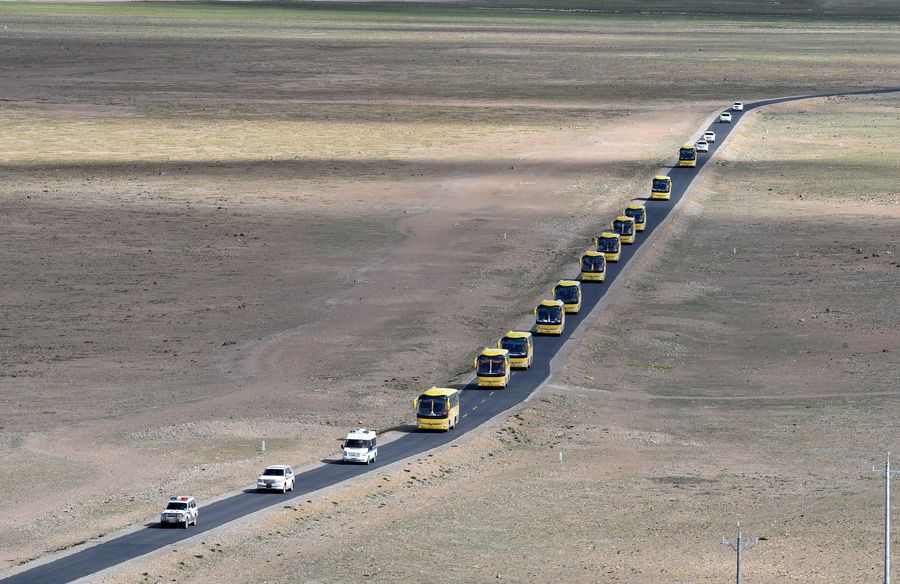
Photo taken on June 18, 2018 shows a fleet of vehicles on the way to relocate people from Rongma Town of Nyima County to Lhasa. (Xinhua/Chogo)
IMPETUS FROM WITHIN
In recent years, Tibet has gradually cultivated and developed characteristic industries such as highland barley, yak and ethnic handicrafts.
In August, 660 poor families in Luoma Town of Seni District of Nagqu received a one-time bonus of 528,000 yuan from Garde demonstration poverty alleviation animal husbandry base.
The demonstration base covers an area of 666 hectares, including livestock breeding areas, dairy processing areas, artificial grass areas and other businesses.
"The company has five outlets in Lhasa with daily sales of about 15,000 yuan. It buys 4,500 kilograms of milk a day from local herders."
The 52 poor families can earn as much as 4,500 yuan a month by engaging in milking, quality inspection and sales.
Trinley Tharje, head of Seni District, said the company has not only helped increase the added value of agricultural products, but also created job opportunities for local people.
By the end of the year, 70 percent of the net profit will be distributed to the poor, and the goal of lifting Seni District out of poverty this year will be smoothly achieved, he said.
Statistics show that since the beginning of 2016, construction of 2,567 poverty alleviation projects have been started in Tibet, of which 1,701 have been completed. By the end of August, the region had lifted 222,000 poor farmers and herdsmen out of poverty through industrial development.
Tourism has also been a major poverty-alleviation measure.
The regional government has encouraged rural residents and herdsmen to open family inns. The average annual income of the total of 570 family inns surpassed 100,000 yuan, and some even reached 300,000 yuan, said Huang Yongqing, head of the regional tourism development department.
The number of tourists to visit Tibet topped 33.7 million, up 31.5 percent year on year, while income from tourism increased by 29.2 percent to 49 billion yuan, according to statistics.
The region helped 32,000 people rise out of poverty by developing rural tourism last year, according to the regional tourism authorities. It plans to help another 100,000 farmers and herdsmen gain employment through rural tourism this year.
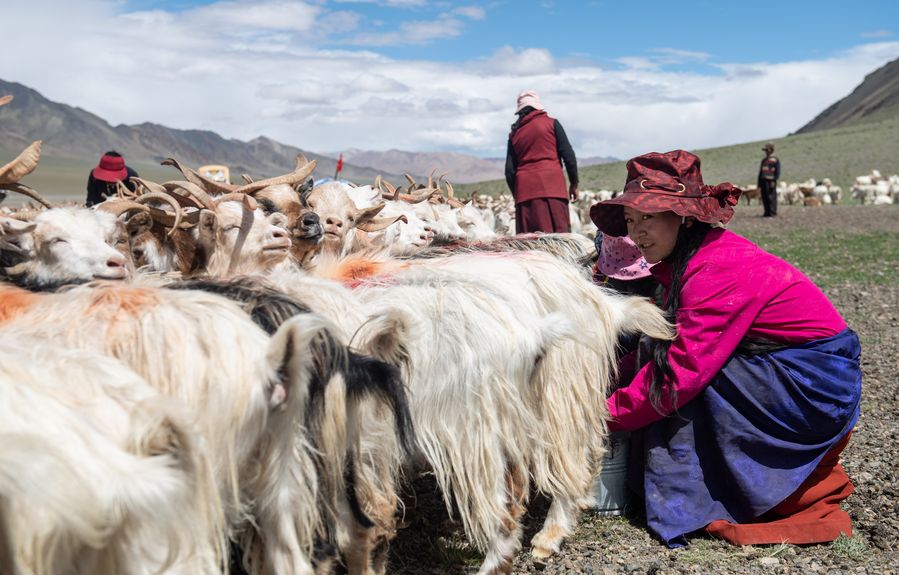
A herdswoman from a cooperative milks sheep in Rutog County of Ngari Prefecture, southwest China's Tibet Autonomous Region, Aug. 4, 2019. (Xinhua/Jigme Dorje)
(Video reporters: He Cheng, Lodro Gyaco; Video editor: Zhang Xinyi)■