



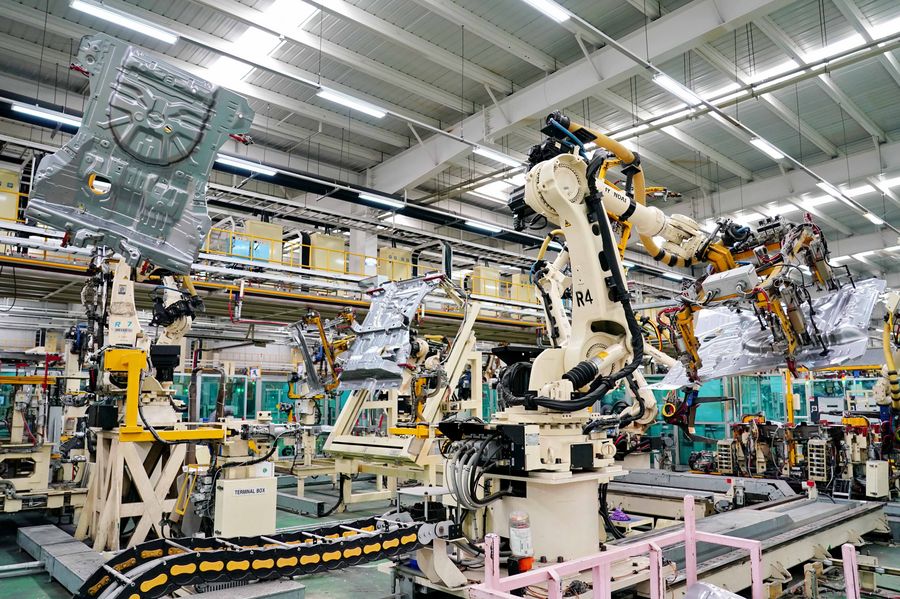
Photo taken on July 6, 2019 shows robots working on a production line at a local automobile technology company in north China's Hebei Province. (Xinhua/Yang Shiyao)
Improved labor productivity and slowing growth of broad manufacturing relative to services are the primary reasons for employment decline in China's manufacturing sector, a U.S. economist says.
WASHINGTON, Aug. 31 (Xinhua) -- The employment decline in China's manufacturing sector primarily reflects improved labor productivity and the slowing growth of broad manufacturing relative to services, said a U.S. economist, refuting President Donald Trump's argument that China has lost millions of jobs as a result of his tariffs.
"This claim is delusional," Nicholas Lardy, a senior fellow at Peterson Institute for International Economics based in Washington D.C., wrote in an article published Thursday, referring to the president's recent tweet that "China has lost 5 million jobs and two million manufacturing jobs due to the Trump Tariffs."
The figure appears to be based on a report by the Beijing-based Chinese securities firm, China International Capital Corporation Limited (CICC), Lardy said.
The report showed employment in "broad manufacturing," which consists of mining, manufacturing, utilities and construction, has fallen by 5 million since July 2018, when the U.S. government first imposed tariffs.
However, the CICC report also said that employment in broad manufacturing shrank by almost 8 million a year between 2015 and 2017, Lardy noted. "So, the contraction of employment in broad manufacturing has not increased since the trade war began in July 2018. Instead, it appears to have slowed."
As growth in the manufacturing sector slows, services have become an increasingly important contributor to China's growth, and total employment continued to expand throughout this period because of rapidly expanding demand for labor in services, said the veteran China watcher.
While Chinese exports to the United States have fallen by over 10 percent since tariffs were first imposed in mid-2018, its exports to the rest of the world have expanded by "more than enough" to offset the loss of sales to the United States, he said, noting that employment losses due directly to the trade war seem to be "de minimis."
Total sales in the subsectors of manufacturing most exposed to the tariffs imposed by the United States in July and September 2018 have grown rather than fallen, Lardy said.
While employment in these exporting subsectors has fallen, the decline is smaller than the average for manufacturing as a whole, he added.
"The assertion that China is suffering from a crisis of employment as a result of the tariffs imposed by the United States is, therefore, not based on the evidence," Lardy said. "Basing trade policy on a bogus premise may be an effective way to sell it to the U.S. public, but it is hardly likely to work with the Chinese."