




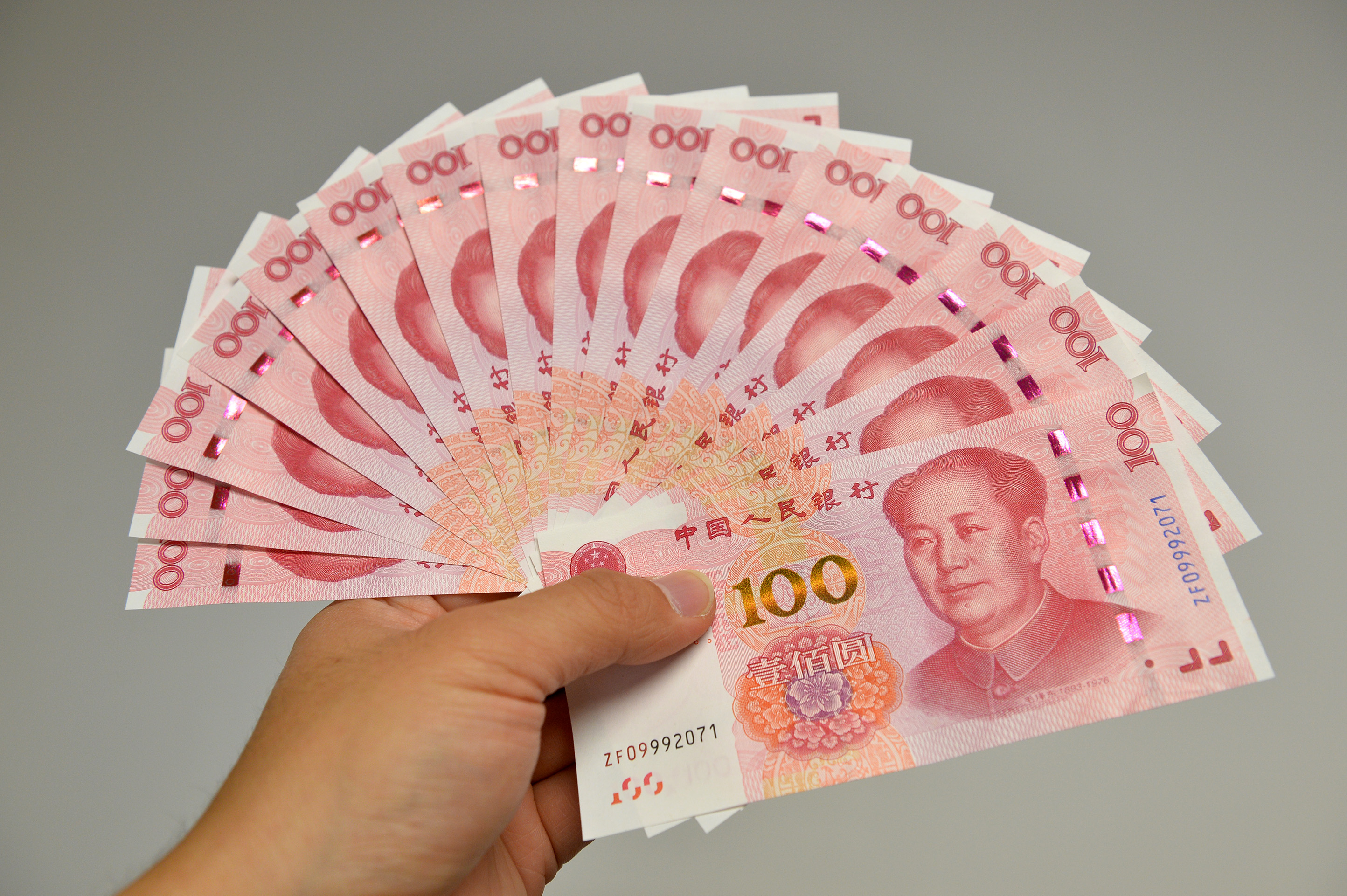
Photo taken on Nov. 12, 2015 shows the then newly-released 100-yuan bank notes in Beijing, capital of China. (Xinhua/Li Xin)
"China has never used and will not use the RMB exchange rate as a tool to deal with the trade frictions," the People's Bank of China said in an online statement.
NEW YORK, Aug. 7 (Xinhua) -- The United States labeling China a currency manipulator following the weakening of the Chinese yuan (CNY) is an action opposed by U.S. market players and scholars and has rattled markets.
Such a move would be "mostly a symbolic gesture" that cannot cause "significant ramifications" against China, and the intensifying trade war would hamper U.S. and global growth momentum, according to some U.S. financial professionals and scholars.
U.S. LABELING A SYMBOLIC GESTURE
The U.S. Treasury has designated China as a currency manipulator, citing the Omnibus Trade and Competitiveness Act of 1988. Under the law, the treasury should initiate negotiations first through the International Monetary Fund (IMF) or bilaterally, which normally takes a year.
"Opening an investigation through the IMF is mostly symbolic as the IMF is unlikely to declare China as a currency manipulator," said a group of economists at Bank of America (BofA) Merrill Lynch in a report on Tuesday.
There is the potential for the U.S. administration "to invoke other trade laws, but they would also be generally symbolic with few significant ramifications," said the BofA Merrill Lynch Global Research report.
That's because the IMF estimated that the Chinese currency was appropriately valued relative to fundamentals, while the U.S. dollar was 6-12 percent overvalued in a report last month.
"In the meantime, the question is what this means for the likelihood that the U.S. will take steps to intervene in the FX (foreign exchange) market and weaken the dollar in response," said the economists.
In this regard, Jeffrey Sachs, a senior United Nations advisor and renowned economics professor at Columbia University, held that the weakening of the CNY does not suggest China is manipulating its currency.
"This is true even according to the arbitrary standards of America's own trade laws, much less according to objective standards," Sachs said in a published article on Tuesday.

Photo taken on Dec. 28, 2018 shows the No. J000000001 commemorative banknote of the Chinese currency renminbi during a ceremony in Shijiazhuang, north China's Hebei Province. (Xinhua/Li Xin)
He further pointed out that the U.S. Treasury acknowledged in its report in May that China does not meet the criteria of a currency manipulator, because there is no sign China tried to expand its current account surplus through currency manipulation and the country's foreign exchange reserves have been stable for the past two years.
The Treasury's reversal yesterday is arbitrary, just as the U.S. imposition of new tariffs against China was last week, said the scholar.
Similarly, investment strategists with the Swiss investment bank UBS also cautioned in a research report on Tuesday against framing the depreciation of the CNY as the start of a competitive devaluation, as the yuan's fall reflected "worsening economic fundamentals and rising trade tariff risks."
They also mentioned that Chinese policymakers appeared "wary of unhinging expectations for yuan stability," because Beijing "is well aware of the negative costs linked to currency depreciation, from capital markets to capital outflows."
"We would view Monday's moves as a reminder that the yuan exchange rate may reflect external headwinds, rather than the start of a competitive devaluation policy," they said.
The People's Bank of China (PBOC), or China's central bank, said Tuesday that China will not use the currency as a tool to deal with trade disputes and the U.S. label does not meet the quantitative criteria for the so-called "currency manipulator" set by the U.S. Treasury.
"Though the U.S. has continued to escalate the trade dispute since early 2018, China has kept its promise of not carrying out competitive devaluation. China has never used and will not use the RMB exchange rate as a tool to deal with the trade frictions," the PBOC said in an online statement.
Although the CNY would be under downward pressure in the short term because of the ongoing trade war, it still has some space to fluctuate, Tim Fang, head of global markets of Hong Kong-based investment bank AMTD International, told Xinhua on Monday.
"I believe in PBOC's capability (in keeping the yuan stable). I'm not very concerned," he said.
RISING TRADE WAR TO HAMPER GROWTH POTENTIAL
The current developments over tariffs and currency would "present a significant headwind for global growth, corporate profits, and markets," said UBS strategists.
The "unexpected" U.S. labeling has caught global financial markets off guard, fueling market panic over a long-term U.S.-China trade dispute, Fang said.

Photo taken on March 13, 2018 shows the headquarters of the People's Bank of China in Beijing, capital of China. (Xinhua/Cai Yang)
"It is irresponsible of the U.S. administration to designate China as a currency manipulator," Fang said. "The U.S. government once took the initiative to depreciate the U.S. dollar to incentivize economic recovery, especially after the financial crisis. But it was seldom questioned."
What's worse, Steven Gu, a Tennessee-based attorney and certified public accountant, told Xinhua that he remained gravely concerned over the global economic growth potential, as the U.S.-China trade war has deteriorated at a much faster speed that exceeded most people's expectations.
U.S. financial services firm Moody's also said in a note that the escalation of trade tensions would increasingly weigh on the global economy and supply chains "in an environment of already decelerating growth in the U.S., the euro area and China, with the uncertainty dampening business investment and trade flows."
An extended period of trade conflicts could cause "more downward pressure on global trade and growth momentum," said BofA Merrill Lynch economists, adding that there would be greater uncertainty that weighs on business investment, and tighter financial conditions if markets continue to react negatively.
"With no end in sight, there are significant downside risks to our forecasts for U.S. and global growth. If the trade war escalates -- this could include a more explicit currency war -- uncertainty would be considerably higher and financial conditions much tighter," they cautioned.
"Consumers will also be hit more directly from this latest round of tariffs since there is a greater share of consumer goods in this basket of imports," they added.
More significantly, from Sachs' perspective, U.S. protectionist policies represent "the biggest threat" to the global open system in modern times, as international trade is based on a mutually beneficial, not winner-or-loser mentality.
"Trade wars are bad, and easy to lose. In fact, everybody is losing," Sachs wrote.