




By Xinhua writers Yu Fei, Quan Xiaoshu and Li Guoli
BEIJING, July 20 (Xinhua) -- After orbiting the earth 16,209 times, it burned itself into ashes, flaming out in a dazzling display as its last gift to humanity.
China's space lab Tiangong-2 reentered the earth's atmosphere under control Friday night, with a small amount of its debris falling into the predetermined safe sea area in the South Pacific, the China Manned Space Agency said.
Tiangong-2's controlled reentry into the atmosphere marks the successful completion of all the tasks in the space lab phase in China's manned space program, said Zhou Jianping, chief designer of China's manned space program.
"It's hard to say goodbye to Tiangong-2, but considering reliability- and safety-related factors, we have to drive it out of orbit," said Zhu Zongpeng, chief designer of Tiangong-2 from the China Academy of Space Technology.
"To let Tiangong-2 'retire' by choice is to ensure the absolute safety of its departure," Zhu said.
"As the first to enter Tiangong-2, I'm happy that the space lab has successfully completed its tasks, though I'm also missing it since it was our home in space," said astronaut Jing Haipeng, who spent his 50th birthday on Tiangong-2 on Oct. 24, 2016.
"My memory of the 30 days on Tiangong-2 with Chen Dong is still fresh. We conducted many scientific experiments such as raising silkworms and growing plants in space," Jing said.
"China is stepping up efforts to prepare for the construction of the space station. We are confident that a space station belonging to the Chinese people is coming soon," he added.
"The 30 days on Tiangong-2 were the happiest and most unforgettable experience in my life, and the most precious and valuable time to cherish," said astronaut Chen Dong.
"Tiangong-2 was the place to realize my space dream," said Chen, adding that "China's space station, a more powerful, advanced and comfortable home for astronauts, is awaiting us."

The screen at the Beijing Aerospace Control Center shows the two Chinese astronauts Jing Haipeng and Chen Dong entering the space lab Tiangong-2 on Oct. 19, 2016.
The space lab is the prelude to the construction of China's space station, aiming to test the key technologies needed for the permanent space station, Zhou said.
Tiangong-2, an improved version of Tiangong-1, is considered China's first space lab. Launched on Sept. 15, 2016, the space lab has worked in orbit over 1,000 days, much longer than its 2-year designed lifespan.
Comprising an experiment module and a resource module, the space lab has a total length of 10.4 meters, a maximum diameter of 3.35 meters and a takeoff weight of 8.6 tonnes. After its solar panels are unfolded, its wingspan reaches 18.4 meters.
Tiangong-2 docked with both the Shenzhou-11 manned spaceship and Tianzhou-1 cargo spacecraft.

The diagram shows the procedure of Shenzhou-11 manned spacecraft automated docking with Tiangong-2 space lab on Oct. 19, 2016. (Xinhua/Qu Zhendong)
China made breakthroughs in a series of key technologies through the Tiangong-2 mission, such as medium-term space residence of astronauts and in-orbit propellant refueling, accumulating important experience for building and operating China's future space station.
More than 60 space science experiments and technological tests have been carried out on the space lab. For instance, the first-ever cold atom clock working in space was tested on Tiangong-2. The clock was so accurate that it would only lose one second every 30 million years.
A device named POLAR installed atop Tiangong-2, which was jointly developed by Chinese and European scientists, has detected 55 gamma-ray bursts, the strongest explosions in the universe.
China also tested an accompanying micro satellite, which was launched from Tiangong-2 and took high-resolution pictures of the connected space lab and Shenzhou-11 manned spaceship.

Photo taken by high-resolution camera shows Tiangong-2 space lab and Shenzhou-11 manned spacecraft on Oct. 30, 2016. (Chinese Academy of Sciences/Handout via Xinhua)
Through operating a mechanical arm, the two astronauts tested in-orbit maintenance technology by man-machine collaboration, laying the technical foundation for developing robots on a future space station.
The two astronauts also conducted popular science experiments designed by middle school students from Hong Kong, including raising silkworms in space.
Zhang Yunhua, a researcher at the National Space Science Center of the Chinese Academy of Science (CAS), said Tiangong-2 has provided valuable opportunities for Chinese scientists to test their new technologies and methods. His team developed a three-dimensional microwave altimeter and tested it on Tiangong-2 to improve China's ocean observation capability.
In 1992, China started the manned space program with a three-step strategy.
The first step, to send an astronaut into space and return safely, was fulfilled by Yang Liwei in the Shenzhou-5 mission in 2003.
The second step was developing advanced space flight techniques and technologies including extra-vehicular activity and orbital docking. This phase also included the launch of Tiangong-1, a transitional platform to test the docking technology, and Tiangong-2.
So far, China has launched 11 manned spaceships, one cargo spacecraft, Tiangong-1 and Tiangong-2, sending 11 astronauts into space, completing the first two steps of the manned space program.
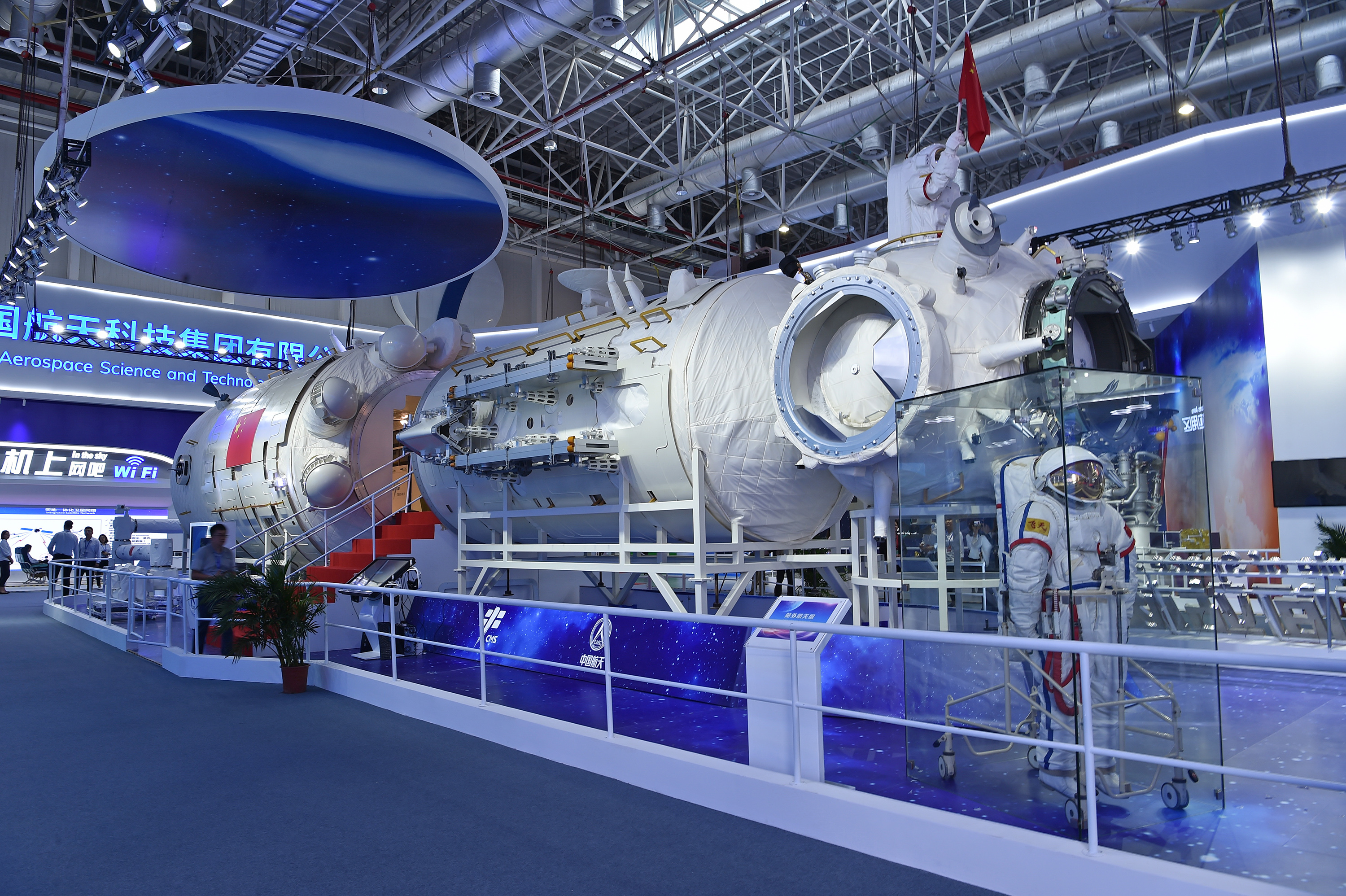
Photo taken on Nov. 5, 2018 shows a full-size model of the Tianhe core module of China's space station exhibited at the 12th China International Aviation and Aerospace Exhibition (Airshow China) in Zhuhai, south China's Guangdong Province. (Xinhua/Liang Xu)
The next step will be to assemble and operate a permanent manned space station.
The success of the Tiangong-2 mission has ushered in the era of building China's space station, which is expected to be completed around 2022.
Weighing 66 tonnes, the Tiangong space station will be T-shaped with the Tianhe core module at the center and the Wentian and Mengtian experiment capsules on each side.
The station, orbiting 340 to 450 kilometers above the earth's surface, could be enlarged to 180 tonnes if required and accommodate three to six astronauts. It is designed to last at least 10 years, but this could be prolonged through in-orbit maintenance, said Zhou Jianping.
The development of China's space station is progressing well. A test version of the core module has been completed, and the test version of the two experiment capsules is under development, Zhou said.
Sixteen experiment racks will be installed on the space station to support hundreds of space research projects, according to the Technology and Engineering Center for Space Utilization of CAS.
The in-depth cooperation between Chinese and European scientists in developing POLAR on Tiangong-2 has laid a solid foundation for greater and deeper cooperation between the two sides, said Sun Jianchao, a member of the team from the High Energy Physics Institute of CAS.
Scientists from China, Switzerland, Germany and Poland plan to continue their cooperation and develop POLAR-2 on China's space station, which is expected to contribute to the study of questions including the formation of black holes, said Sun.

Photo taken on Nov. 5, 2018 shows a full-size model of the Tianhe core module of China's space station exhibited at the 12th China International Aviation and Aerospace Exhibition (Airshow China) in Zhuhai, south China's Guangdong Province. (Xinhua/Liang Xu)
China is also selecting new astronauts for the space station missions. After the construction of the station is completed, China welcomes overseas astronauts to work together with domestic astronauts aboard China's space station. Foreign spacecraft can also be docked with China's space station if they use a Chinese docking mechanism, Zhou said.
He mentioned that China will develop and launch a two-meter-caliber space telescope, which will share the same orbit with the space station.
The space telescope, with a field of view 300 times larger than that of the Hubble Space Telescope, is expected to provide observation data for astronomical and physical studies to help scientists better understand the universe.
Exploring the universe is the common cause of mankind. China upholds the principle of peaceful utilization of space and win-win cooperation, and actively collaborates with scientists from other countries to explore the universe through developing new technologies and advanced facilities, Zhou said.
Nine scientific experiments involving 23 entities from 17 countries have been accepted to be conducted onboard China's space station, the United Nations and China announced recently, which shows that China's manned space program is stepping from independent development to global cooperation.
"Although China has been excluded from the International Space Station, China welcomes international cooperation on its own space station with an open mind," said Zhou.
China's great achievements over the past four decades are the outcome of reform and opening-up. As a beneficiary of open cooperation, China actively promotes the development of a community with a shared future for humanity and the Belt and Road Initiative, which shows the open attitude of the Chinese government, Zhou added.
(Liu Yiwei contributed to this story; Video reporter: Wang Dongming; Video editor: Yin Le)