by Levi J Parsons
SYDNEY, July 19 (Xinhua) -- With the recent success of the TV series Chernobyl, the topic of nuclear contamination and the way it's managed has once again been thrust back into the public spotlight.
Although the terrifying meltdown happened more than three decades ago, the long-lasting environmental impact of the disaster continues to remind us just how devastating a nuclear disaster can be.
Likewise, the international scientific community still shares concerns about the radiation levels on Japan's east coast, following the 2011 Fukushima nuclear accident when the facility was struck by a powerful earthquake and an ensuing tsunami.
But while these two places are by far the most widely known radioactive sites in the world, there's another location which sends geiger counters even higher.
PARADISE LOST
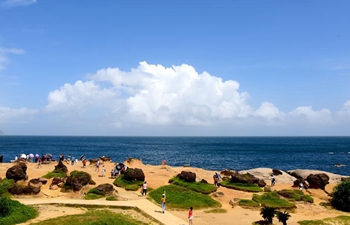
Tucked away in the tropical South Pacific Ocean halfway between Australia and Hawaii lies the Marshall Islands -- a remote sun-drenched paradise made up of 29 atolls and approximately 70,000 residents.
Despite sounding idyllic and picturesque, radiation levels in the Marshall Islands in some areas are around 1,000 times higher than both Chernobyl and Fukushima.
This is because U.S. forces performed 67 nuclear tests in the palm-tree-laden nation during the years following World War II from 1946 to 1958.
"I think that there are certain islands that should be avoided by the local people," University of Auckland nuclear physicist David Krofcheck told Xinhua.
"Bikini Island and Naen Island still appear to have high levels of gamma radiation, including probable areas with very large (Chernobyl levels) of gamma ray activity."
"Enjebi and Runit Islands also have high gamma ray levels which should be avoided by people."
UNPRECEDENTED ENVIRONMENTAL CONTAMINATION FOR INDIGENOUS PEOPLE
Home of the first and largest-ever hydrogen bomb tests, the Marshall Islands have been brought into the public eye this week thanks to the new research from the U.S. Columbia University, outlining the severity of problems that local people have been forced to deal with.
"Two atolls, Bikini and Enewetak, were used as ground zero for the tests, which caused unprecedented environmental contamination and, for the indigenous peoples of the islands, long-term adverse health effects," the researchers said in their report.
"In addition to the populations of Bikini and Enewetak, the people of Rongelap and Utirik were also affected by radioactive fallout from the largest nuclear test the United States has ever conducted, the Bravo test held March 1, 1954."
On the Island of Bikini, soil testing confirmed that concentrations of particular radioactive materials "were up to 15-1,000 times higher than in samples from areas affected by the Chernobyl and Fukushima disasters," the researcher said.
Although, the U.S. military removed people from islands near the testing zone at the time of bomb blasts, some residents are believed to have returned over the years, sparking calls that the U.S. government should be doing more to monitor the situation.
While Washington did enact an environmental remediation program in the past to reduce radioactivity in the soil across several northern islands, according to Krofcheck, "they gave up due to the expense."
IF PEOPLE RETURN, THEY WILL BE EXPOSED TO LONG TERM CANCER RISK
The nuclear fallout from U.S. bomb testing is not the only radiation risk impacting the Marshall Islands.
On Runit, a toxic plutonium waste dumping site that was sealed up using a giant concrete dome is now also posing a monumental threat to the area.
"The dome was only meant to be a temporary solution until the U.S. came up with a permanent plan," Australian Broadcasting Corporation reporter Mark Willacy said in a 2017 TV program investigating the matter.
"They were supposed to line it with concrete, but that never happened because of cost considerations. So, as the sea level has risen, the groundwater level has risen and therefore you have groundwater penetrating inside the dome, because a lot of this atoll is obviously sand and coral. It's permeable material."
"It's not a good idea to resettle populations in most northern islands," said Krofcheck.
"The U.S. government data showed that cancer risks were not able to be distinguished from the normal number of cancers expected in a population, but this was for people eventually evacuated from contaminated islands," he said.
"If people return to these four islands, they will be exposed to radioactivity in food and the environment that will enhance their long-term cancer risk just like Chernobyl."
"Such measurements of the effects of nuclear weapons testing in the Marshall Islands must continue on a regular basis into the indefinite future," he added.
As part of a reparations initiative for the nuclear testing program, Marshall Island residents were granted the right to live and work in the United States without a visa. Over one-third of the population have already moved as a result.