




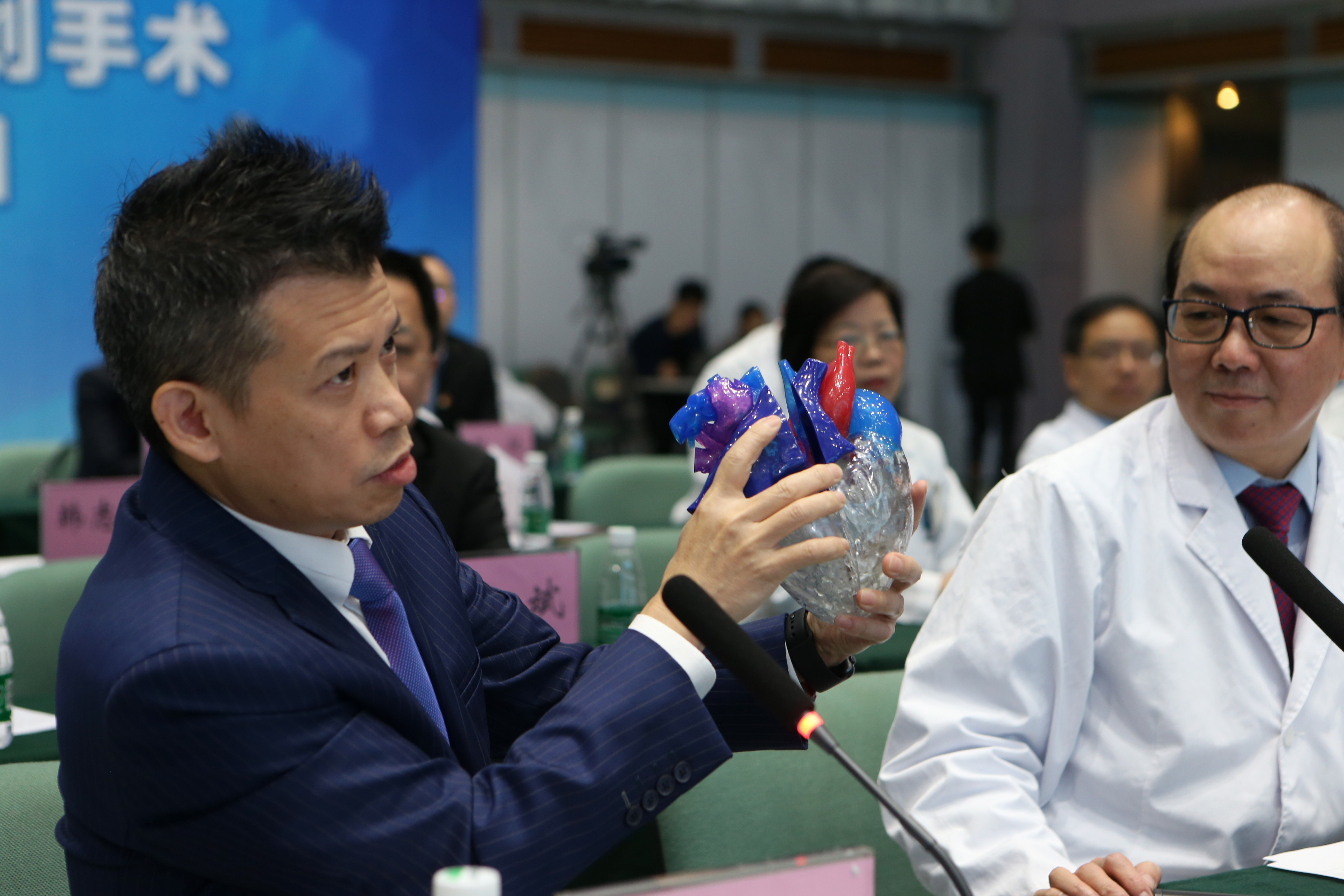
With a 5G connection, heart surgeon Guo Huiming gave instructions using a microphone and a 3D heart to surgeons in a operating room 400 km away. (Xinhua/Zhang Jiayang)
By Xinhua writers Yuan Quan, Jing Huaiqiao, Quan Xiaoshu
GUANGZHOU, June 18 (Xinhua) -- Heart surgeon Guo Huiming has a prescription for what ails China's medical services: 5G technology.
He works at Guangdong Provincial People's Hospital, a leading medical center in Guangzhou, which is pioneering 5G-assisted medical services that enable its specialists to help in delicate operations on patients hundreds of miles away.
About 80 percent of China's medical resources are concentrated in big cities, such as Beijing and Shanghai, and 80 percent of these are in big public hospitals, where patients flood in to see eminent doctors, overcrowding the hospitals and sometimes straining doctor-patient relations.
Guo believes telemedicine with superfast wireless technology will help tackle the problem, allowing more patients to receive high-quality treatment at local clinics near their homes.
REMOTE GUIDANCE
Guo, 54, is a tech fan. He wears an Apple Watch, speaks Cantonese to Siri on his iPhone and plays vinyl on a Sony turntable in his office.
Two months ago, he made headlines by using 5G technology to direct minimally invasive heart surgery on a patient 400 km away via live video stream.
During the four-hour operation, Guo, the chief of the hospital's cardiac surgery unit, sat in front of a big screen, and gave instructions using a microphone and a 3D heart. Wearing a suit and a tie, he looked like Marvel character Doctor Strange.
Guo said only four doctors in his team were capable of such surgery. Last year, his team performed over 700 minimally invasive heart operations.
Previously he had to drive several hours to remote county hospitals to conduct operations as well as seeing patients in Guangzhou.
"About 70 percent of my patients are from outside Guangzhou," Guo said.
For patients of critical diseases from distant rural areas, traveling to the hospital can be challenging and time-consuming. "Some may unfortunately die on the way," said Yu Xueqing, president of the hospital.
Telemedicine was mainly conducted via phone or video. It was not common, largely because of poor technology, with unstable signals, slow transfer speeds and low definition, which made it impossible for doctors to oversee procedures remotely.
"Before 5G, we dared not conduct remote surgery," Yu said. "A lag time of a few seconds between devices and the surgeons could result in vital mistakes."
IMPROVED SERVICES
Improving the data transfer speed at least 10 times faster than 4G technology, 5G has a lag time of just a tenth of a second.
It helps inject new vitality to county hospitals like the People's Hospital of Gaozhou, which performed more than 100 minimally invasive operations last year.
Although excellent in treating cardiovascular diseases, the Gaozhou hospital still lags far behind provincial hospitals in terms of treatment quality.
In a recent operation for a 41-year-old woman patient, Gaozhou hospital invited Guo to give advice and guidance in real time through its telemedicine platform.
Sitting at an operating theater in Guangzhou, a six-hour drive from Gaozhou, Guo used a video marker to highlight an area on the patient's body, and told the chief surgeon to move the cutting point 3 cm upward to avoid harming a nerve.
If without 5G, he would have to freeze the image to draw, but the surgeon might already move on or could not see clearly, and would miss the instruction.
Guangdong Mobile and tech giant Huawei have provided technical support for the 5G surgery.
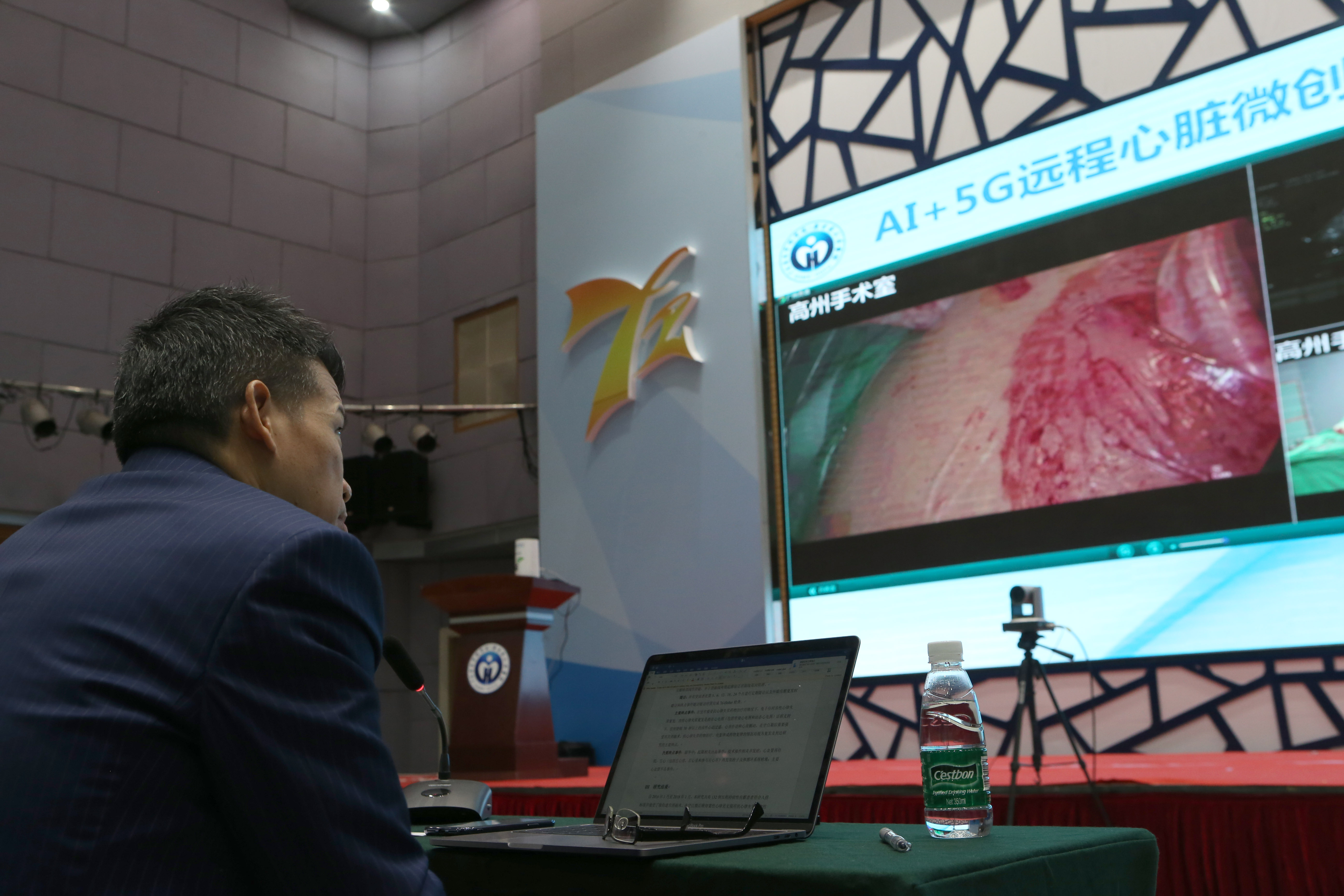
Sitting in front of a big screen, Guo gave guidance to the operating room in real time. (Xinhua/Zhang Jiayang)
Two weeks before the operation, also with a 5G connection, Guo's team built a 3D heart model with CT images of the patient, which gave him a 360-degree view of the heart.
County hospitals are not capable of building a 3D model. Previously, gigabyte-sized CT images had to be transferred between the hospitals by hard drive or downloaded over several hours from the internet, but now it only takes minutes on the 5G network.
"We could see the deformities clearly. It helped us reduce errors and improve efficiency," Guo recalled.
He thinks the 5G system will help medical staff in remote areas master heart surgery faster.
A trainee doctor has to practice at least 100 times before becoming head surgeon in a minimally invasive operation.
But local medical staff had few opportunities to learn from well-trained surgeons. The hospital invited professionals from Guangzhou to help operate just four or five times a year.
The 5G-assisted services at a lower cost can also help county hospitals attract more patients.
He Yong, chief surgeon at the county hospital, calculated that such an operation would cost the patient 20,000 yuan (about 2,900 U.S. dollars) if done by local staff and another 10,000 yuan with invited specialists.
But if the patient chose to have the surgery in Guangzhou, the payment would rise to 40,000 yuan, said He. Besides, the family members will have to pay for accommodation and travel.
Surgery through 5G required no extra payment, added He.
MORE RESOURCES
Guangdong was the vanguard of China's reform and opening-up, and today is home to many leading hospitals and booming high-tech businesses.
The southern province is also the pioneer of China's health care reform, with efforts to develop a hierarchical medical system and the internet-based treatment.
Medical services in remote areas are still far from satisfying. Many county- and township-level hospitals are short of advanced equipment and well-trained staff.
Since 2017, Guangdong has invested 50 billion yuan on improving health care infrastructure in underdeveloped regions, and encouraged large hospitals to provide assistance in training.
According to the provincial health authorities, the hospitalization rate of county hospitals reached 83.5 percent last year. In Gaozhou, the rate is 90 percent, indicating that more patients now see doctors locally, rather than go to big cities.
He Yong welcomed cooperation with top hospitals through 5G technologies, but noted county hospitals have to spend more on high-quality equipment. "It is still a challenge for us," He said.
In May, doctors with the Cancer Center of the Sun Yat-sen University, in Guangzhou, used 5G to remotely direct three operations in Shenzhen, Zhuhai and Gaozhou in real time.
Liu Zhuowei, vice president of the center, said the attempt proved the 5G-assisted treatment was efficient.
Guo Huiming expects 5G to provide greater surgical safety, but the main advantage will be having specialists from large hospitals assist more junior colleagues elsewhere.
"I hope big hospitals will not be overcrowded, and we will have more time for research and treating critical patients," said Guo. Enditem