




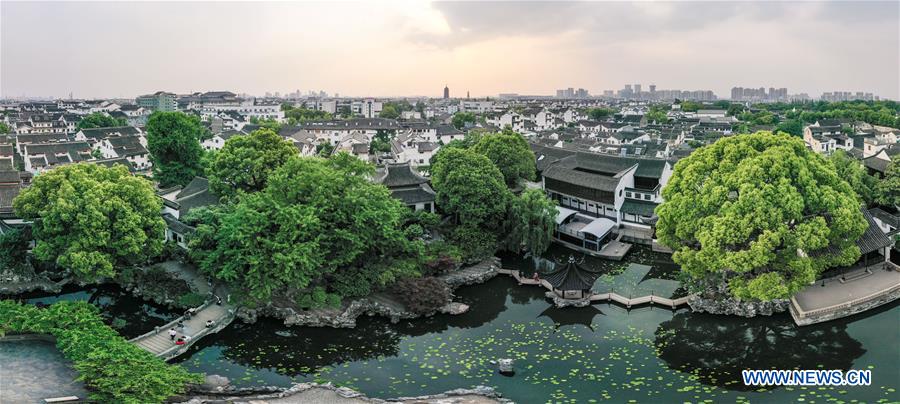
Aerial photo taken on May 9, 2019 shows a view of the Lion Forest Garden in Suzhou, east China's Jiangsu Province. (Xinhua/Li Bo)
by Xinhua writers Wang Jingzhong, Luo Zhen, Ni Hanlin
SUZHOU, Jiangsu, June 5 (Xinhua) -- When Marco Polo first visited Suzhou in 1276, the Venetian traveler was instantly smitten by the criss-cross canals, grand lakes and people who "possess silk in great quantities".
The city on the lower reaches of the Yangtze was "very great and noble," he wrote, calling it "Venice in the East."
For centuries, the waterways have brought prosperity to Suzhou, which in turn allowed the wealthy locals to build spectacular gardens.
About a 20 minute ride by high-speed train from Shanghai, Suzhou is one of the richest cities in China, with its more than 100 classical gardens considered some of the most beautiful in the country, and nine of them serving as UNESCO world heritage sites.
Campbell MacGregor, from Scotland, has been living in Suzhou for several years. After traveling in many parts of the world, he settled in the city, saying he is fond of the classical gardens and the easy way of life.
"In many cities, you cannot get away from the madding crowd. But Suzhou provides hundreds of gardens for you to go to. As soon as you walk through the gates and behind those big walls, you've just gone on to a different part of the universe," he says.
When in a Suzhou garden, Campbell said he finds "inner peace."
DESIGN AND PHILOSOPHY
Though most are now open to the public, the Suzhou gardens used to be private estates of the gentry and officials, which could date back as early as the sixth century B.C. and started to mushroom from the fourth century.
The gardens originated from a desire to retire from the strife of officialdom and to shun worldly affairs, seeking a return to nature and the cultivation of temperament. Over the centuries, they became more elaborate, as new owners added to and modified them.
Throughout history, the garden design has always been intertwined with Chinese literature and the art of landscape painting.
The gardens also represent traditional Chinese philosophies, such as tian ren he yi: nature and humans are one, existing in harmony.
For those who first visit the gardens, they might seem like a puzzle, but every single rock and every blade of grass is purposefully placed with specific meanings.
In the Humble Administrator's Garden, the largest of Suzhou's gardens, Xue Zhijian, the curator of the garden and of the Suzhou Garden Museum, explained the exquisite design and aesthetic value of the gardens.
"This style of Suzhou classical garden has many layers," Xue says. "But there are four distinct elements: the stone, the plant, the architecture and the water." And these elements are woven together in endless combinations.
At a corner of one courtyard in the Humble Administrator's Garden, rocks cut through the outer wall, making visitors feel like they are exploring a mountain, even though they are in the middle of the city.
The plants symbolize different seasons, peonies for spring, lotus in the summer, osmanthus in the autumn and plum blossoms in winter.
"The view changes with the seasons, but also with the angles," Xue says. And this is where the architecture - pagodas, corridors and other man-made structures - comes in. "The architecture leads you to the best view," he says in the Master of Nets Garden. "It's possible to see three completely different vistas simply by walking past a doorway."
About 900 years old, the Master of Nets Garden is one of the oldest in Suzhou. It covers more than 5,000 square meters, over one-fifth of which is taken up by a magnificent pond. "The water is the soul of the garden, it connects and channels every other element," Xue says. "It acts like a mirror here, expanding the space."
SUZHOU "MAZES" VS WESTERN "GALLERIES"
In some gardens, the sense of being lost in nature becomes almost literal: the Lion's Grove manages to fit a maze of nine paths winding through 21 caves across three levels into just a few dozen square meters.
Nothing here is revealed easily. Winding paths and corridors force visitors to slow down to catch and enjoy the poetic scenery.
"I think that it's a respectful connection that Chinese people have toward nature," Campbell says.
The gardens are not just for looking at. Designers created an environment for listening to the rain, smelling flowers and feeling the rocks. Walking around, it provides a multi-sensory, interactive experience.
Suzhou gardens reflect the temperament and aesthetics of ancient Chinese scholars, Xue says. The layout feels freer, more respectful of nature. Though man-made, the gardens are designed to look as natural as possible.
In contrast with maze-like Suzhou gardens, western gardens look more like galleries as they are more regulated and symmetrical, and once stepping inside, one can easily have a panoramic view.
If the western gardens tend to please the eye, Suzhou classical gardens aim more to please the mind.
"GARDEN CITY" GOING GLOBAL
Suzhou is known as a city of gardens, and now is endeavoring to transform itself into a garden city. Preservation and renovation of Suzhou's old city and the gardens within have been carried on for decades.
In Suzhou's old city, the height of architecture must be kept below 24 meters so as not to block views and protect historic skylines, and hundreds of ancient buildings and classic gardens are well preserved.
Among the local residents, local art forms like Pingtan and Kunqu, known as intangible culture heritage, are passed on generation by generation.
"The most striking thing of these gardens is how they bring the natural world into where we live. No matter what season it is, we can enjoy the nature. In Suzhou, people can see the world from inside the gardens." says Wang Zaixiang, a local resident.
But one does not have to live in Suzhou to appreciate the gardens. Some institutes have been working since the 1980s to spread this quintessential style of gardening across the world.
"In the 1980s, we set up the first Suzhou garden in the Metropolitan Museum of Art in New York, and later built more than 30 gardens in other cities and countries, from Canada to Japan," says He Fengchun, director of Suzhou Institute of Landscape Architecture Design. "We want to help people in different countries understand and appreciate the beauty of Suzhou gardens and the culture within."
The gardens of Suzhou are a lasting legacy of Chinese culture, respect for nature and the search for an ideal way in which humans can inhabit it.
As the world's largest developing country, China is embarking on the path of green development while sharing its eco-friendly concept and technologies with other countries. And Suzhou classical gardens are living proof that the desire for harmony with the natural world can have the most beautiful outcomes.
(Xinhua reporters Zhao Ying, Zhang Zhanpeng, Li Guangzheng and Li Xiang contributed to this story)