by Xinhua writer Cheng Lu
BEIJING, March 10 -- Wu Xiangping, 58, speaks fast, walks fast, and eats fast. For him, distances are measured in light years.
An astronomer and academician at the Chinese Academy of Sciences, Wu is currently engaged in the Square Kilometer Array (SKA), an international project to build the world's largest radio telescope.
The SKA will eventually consist of thousands of dishes and up to a million low-frequency dipole-type antennas to be deployed in Australia and several African countries. The total linkage will create a collecting area of about one square kilometer.
"The telescope will have extremely high sensitivity and resolution, with several ambitious science goals such as exploring the cosmic dawn and reionization of the universe, and even searching for extraterrestrial life and civilization on other planets," Wu told Xinhua.
Astronomers' ambitions are, literally, as big as the universe. But Wu, a national political advisor, also cares about things on the Earth.
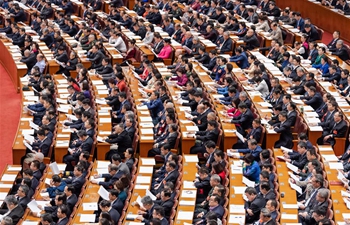
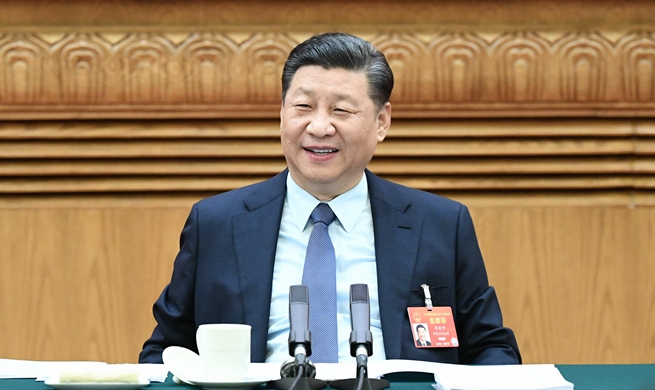
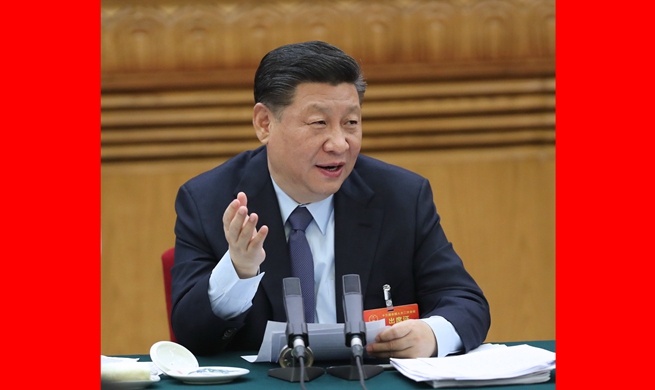
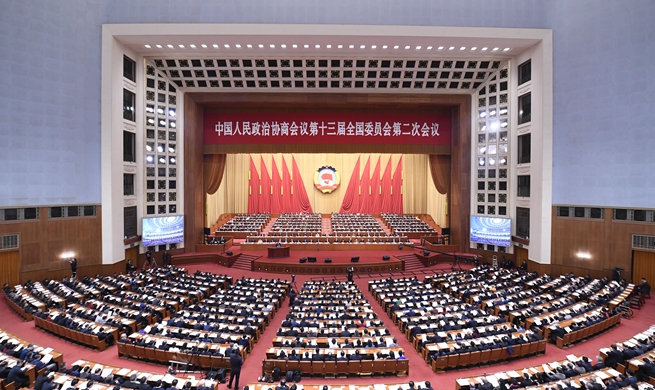
He is among more than 2,000 members attending the ongoing session of the 13th National Committee of the Chinese People's Political Consultative Conference (CPPCC), the top political advisory body, in Beijing.
From all walks of life -- economists, scientists, teachers, doctors, artists and religious leaders -- these political advisors are expected to offer proposals and insight on state affairs.
Over the past seven years, Wu has submitted a dozen proposals on topics including rural education, environmental protection and online canvassing.
Three years ago, he suggested the government allocate more scientific and technological resources to poor areas in western China. He made this proposal based on his personal experience of promoting science and technology in the countryside.
Wu taught courses to rural children in the provinces of Yunnan and Guizhou, as well as Xinjiang Uygur Autonomous Region, and saw how unbalanced educational resources were between urban and rural schools.
"Many rural children have never even seen a scientist. They sit in dim rooms equipped with outdated supplies. I saw a thirst for knowledge in their eyes," Wu said. "Compared with their rural counterparts, urban schools have more experienced faculties and advanced equipment. Some schools even have the chance to invite Nobel laureates to give a lecture."
Wu, himself born in a remote county in northwest China's Shaanxi Province, knows too well the importance of education.
"Knowledge can change a person's life and enrich his imagination," said Wu, who was among only five students passing the college entrance exam in his county in 1978.
"I scored zero in my first English test because I never learned English before college. I was under a lot of pressure," he said. "But given a chance, I caught up with the others very quickly," he said.
Wu saw the same potential in the rural children he met and decided to do something for them.
The proposals submitted by Wu and other national political advisors have helped promote China's rural education. The government work report Premier Li Keqiang delivered Tuesday says the government will develop more equitable and higher quality education.
China will promote the integrated development of urban and rural compulsory education, move faster to improve conditions in rural schools, and promote quality resource sharing, the report says.
Knowledge has no limit. After obtaining a bachelor's degree in physics and a master's degree in theory of electromagnetic fields and microwave technology, Wu shifted his interest to astrophysics because of an article about quasars he read in a popular science magazine.
"I failed to figure out the questions in the article, but this failure inspired me to become an astronomer and seek answers to the fundamental questions of our universe," he said.
Wu has been a star-gazer ever since. It may seem romantic when one peers into the starry sky and wonder, "Where did it all come from?" But for Wu, being an astronomer also means being lonely, "as lonely as the Earth in the universe."
Isolated mountains or secluded valleys are ideal sites for astronomers to deploy their telescopes because there is less pollution caused by human activities.
For 15 years, he has frequently traveled to the Tianshan mountains in Xinjiang to build and work with a low-frequency radio array dedicated to the detection of the earliest luminous objects in the universe.
In the first year, researchers had to sleep in tents in gales though average temperatures could fall as low as minus 30 degrees Celsius in winter. "You couldn't fall asleep. The cold air made it hard to breathe," he recalled.
In the 20th century, few Chinese participated in the world's major scientific and technological advances, but the situation is changing rapidly. Probing the deep sea, exploring the vast space and observing the tiniest of microparticles, efforts have been made at the forefront of almost all fields of science and technology.
"There must be ups and downs for those who stick with a career in science, and a long-term process to accomplish their missions. We have no choice but to fight loneliness and hardship," Wu said.
(Xinhua correspondent Dong Ruifeng contributed to the report.)