
 ?
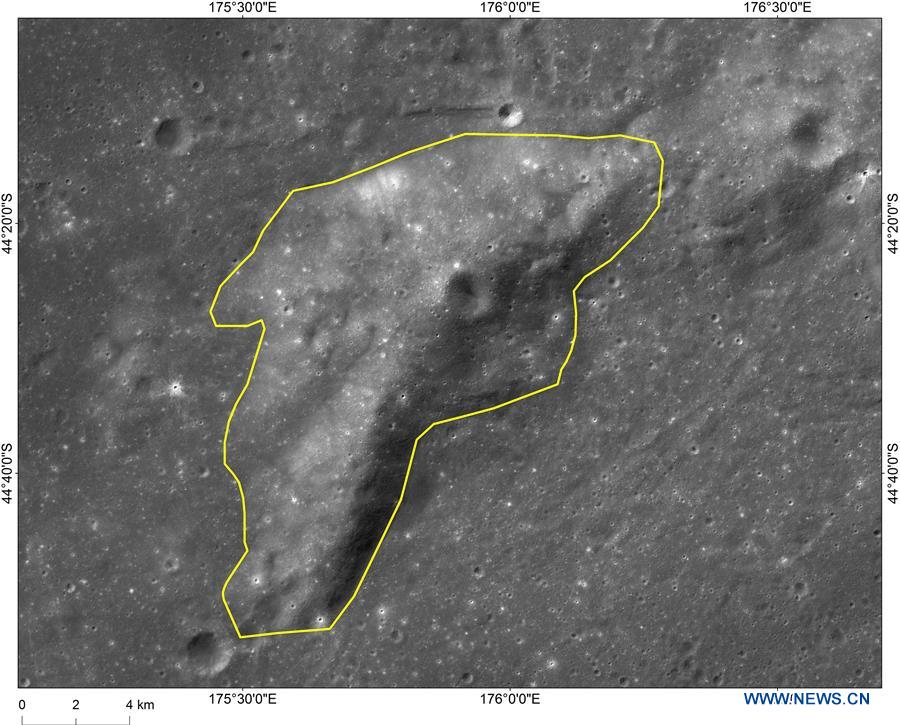
?Photo provided by the China National Space Administration (CNSA) shows the image of Mons Tai, a hill near "Statio Tianhe", the landing site of China's Chang'e-4 lunar probe. The landing site of China's Chang'e-4 lunar probe has been named "Statio Tianhe" after the spacecraft made the first-ever soft landing on the far side of the moon last month. Together with three nearby impact craters and one hill, the name was approved by the International Astronomical Union (IAU), Liu Jizhong, director of the China Lunar Exploration and Space Engineering Center of the China National Space Administration (CNSA), said at a joint press conference held in Beijing Friday. "Tianhe" is the Chinese word for Milky Way and "Statio" is Latin for base. Three craters were given the names Zhinyu, Hegu and Tianjin, three constellations of the twenty-eight mansions in traditional Chinese astrology. The hill used to locate the three craters is named Mons Tai after Mount Tai, a Chinese mountain of historical and cultural significance. The press conference was jointly held by the CNSA, the Chinese Academy of Sciences and the IAU. According to the CNSA, the Chang'e-4 lunar probe made the first-ever soft landing on the far side of the moon on Jan. 3. (Xinhua/CNSA)
BEIJING, Feb. 15 (Xinhua) -- The landing site of China's Chang'e-4 lunar probe has been named "Statio Tianhe" after the spacecraft made the first-ever soft landing on the far side of the moon last month.
Together with three nearby impact craters and one hill, the name was approved by the International Astronomical Union (IAU), Liu Jizhong, director of the China Lunar Exploration and Space Engineering Center of the China National Space Administration (CNSA), said at a joint press conference.
The CNSA held the joint press conference with the Chinese Academy of Sciences and the IAU.
"Tianhe" is the Chinese word for Milky Way and "Statio" is Latin for base. Before "Statio Tianhe," only one place is listed on lunar maps as "Statio," namely "Statio Tranquilitatis" (Tranquility Base), the site the Apollo 11 crew members of the United States landed and walked on in 1969.
According to the CNSA, the Chang'e-4 probe landed at the preselected landing area at 177.6 degrees east longitude and 45.5 degrees south latitude on the far side of the moon at 10:26 a.m. Jan. 3 Beijing Time. The landing area is the Von Karman Crater within the Aitken Basin.
The three nearby impact craters located in the Von Karman Crater form the shape of a triangle with Statio Tianhe at the center, looking like the celestial Summer Triangle prominent in evening skies from June through December in the northern hemisphere.
The defining vertices of the Summer Triangle are at Vega, Altair and Deneb, each of which is the brightest star of its constellation. The three craters were therefore named after the three stars with names in traditional Chinese astrology. Zhinyu is for Vega, Hegu (also called Niulang) for Altair and Tianjin for Deneb.
In Chinese folk tales, lovers Niulang and Zhinyu, one a cowherder and the other a weaver fairy, were separated by the Tianhe (Heavenly River, or the Milky Way), as their love was not allowed by the gods. They could only reunite once a year when a flock of magpies formed a bridge across the river.
In Chinese, Tianjin means galaxy's ferry and bridge across the Milky Way.
Along with relay satellite Queqiao (Magpie Bridge), the naming of Statio Tianhe and the three craters are integrated with rich cultural connotations, said Li Chunlai, deputy director of the National Astronomical Observatories of China and commander-in-chief of the ground application system of Chang'e-4, at the press conference.
At the center of Von Karman Crater, around 46 km northwest to Statio Tianhe, a hill that was used to locate the landing site was named Mons Tai. Regarded as the foremost of the Five Great Mountains of China, Mount Tai is of historical and cultural significance. Mons is Latin for mountain.
It is the IAU's first time approving lunar place names with "Mons" since 1985.
The IAU is the officially recognized authority in astronomy for assigning designations to celestial bodies such as stars, planets and minor planets, including any surface features on them.
So far, a total of 12 lunar features have been named by China.
Liu said naming lunar surface features provides scientists in China and abroad with original data and location standards and will open a new chapter in lunar exploration in the world.
In January 2016, the landing site of Chang'e-3 was named "Guang Han Gong" or "Moon Palace," more than two years after the probe made China's first successful soft-landing on the moon in December 2013.
The Chang'e-4 probe, launched from the Xichang Satellite Launch Center in southwest China on Dec. 8, 2018, touched down on the far side of the moon after orbiting the moon for more than 20 days.
With the communication assistance of the relay satellite Queqiao (Magpie Bridge), the probe sent back the first-ever close-up photograph of the moon's far side.