
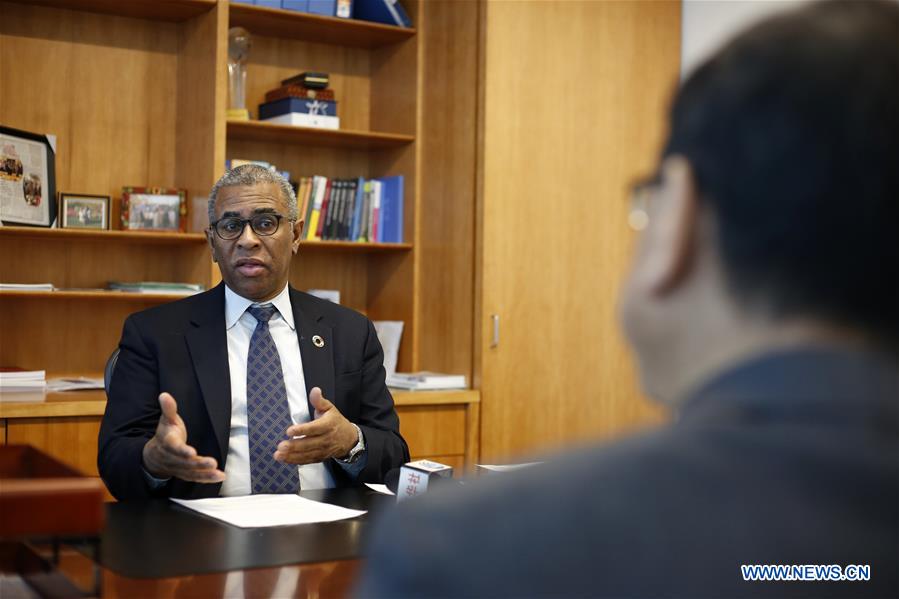
Elliott Harris, United Nations chief economist, speaks to Xinhua during an interview at the UN headquarters in New York, the United States, Jan. 23, 2019. Harris, also UN assistant secretary-general for economic development, has urged the international community to give more heed to the impact of climate change on the global economy, stressing the need to accelerate the shift away from a dependence on carbon-based fuels. (Xinhua/Li Muzi)
by Xinhua writer Wang Jiangang
UNITED NATIONS, Jan. 25 (Xinhua) -- Is climate change only an environmental question? United Nations (UN) chief economist Elliott Harris has given a straightforward "No."
Harris, also UN assistant secretary-general for economic development, has urged the international community to give more heed to the impact of climate change on the global economy, stressing the need to accelerate the shift away from a dependence on carbon-based fuels.
INTENSIFYING RISKS
Speaking to Xinhua in a recent interview, the chief economist said the climate was once considered a "long-term" risk but is "increasingly becoming a short-term impact."
The UN on Monday published its World Economic Situation and Prospects 2019, which lists a number of problems facing the global economy.
"Climate risks are intensifying, as the world experiences an increasing number of extreme weather events. Over the last six years, more than half of extreme weather events have been attributed to climate change," according to the report.
"Climate shocks impact developed and developing countries alike, putting large communities at risk of displacement and causing severe damage to vital infrastructure," the report added.
"Last year, we saw several major disasters related to weather. And these disasters are happening more frequently, and they are more intensive, and they are much more damaging than they ever have been before," said Harris.
The UN chief economist, who assumed the duty in March last year, noted that efforts should be made to reduce greenhouse gas emissions, "so that we can finally achieve the Paris Agreement and put the world on a more sustainable footing."
"For that to happen, policy has to be re-oriented, and we have to shift our investments towards renewable energy sources, new technologies, and resource-efficient technologies that will allow us to be much more sustainable in our production patterns," Harris said.
ECONOMIC IMPACT
Expressing his views on how seriously climate change has affected the global economy, Harris explained that "in certain parts of the world, rainfall patterns have changed and the agricultural productivity is being directly affected... This has a major impact, of course, not only on the economy, but on the welfare of large numbers of people, entire populations."
Rising sea levels have already caused tremendous problems for some of the smaller pacific islands. In large coastal regions such as Bangladesh, flooding has become far more frequent and damaging than it was before. "All of these factors have tremendous economic impact," said the economist.
In 2017, weather disasters led to 18 million internal displacements in 135 countries. Global financial loss from natural calamity reached 335 billion U.S. dollars, less than half of which were insured.
From 1998 to 2017, reported loss due to climate-related disasters reached 2,245 billion dollars, a 151 percent increase than that from 1978 to 1997, according to the report.
Climate-related problems "are becoming more and more pressing," said Harris, adding that "we can no longer think of it as an environmental question. It is an economic question and it is a social question."
BUILDING RESILIENCE
On how to minimize the impact of climate change on the global economy, Harris said "the most important issue is to build up resilience."
"It is cheaper over time to invest in resilient infrastructure, the proper kind of buildings, the right kinds of infrastructure in terms of seaports, and installations on the coasts than it is to recover from a disaster afterwards," he said.
"But the fundamental point is, we have got to accelerate our shift away from the fossil fuel-based economy," he said. "If we do not succeed in shifting away from our dependence on fossil fuel-based energy... we will not be able to mitigate the impact on climate change."
Electricity should be generated in clean and renewable ways, and such technologies have become much more standardized, cheaper and more accessible, the economist said.
All countries should make that transition, Harris added. "The longer they put it off, the more abrupt, disruptive, destructive and costly that transition is going to be today with these alternatives... It is eminently reasonable and economically feasible to start the transition."