
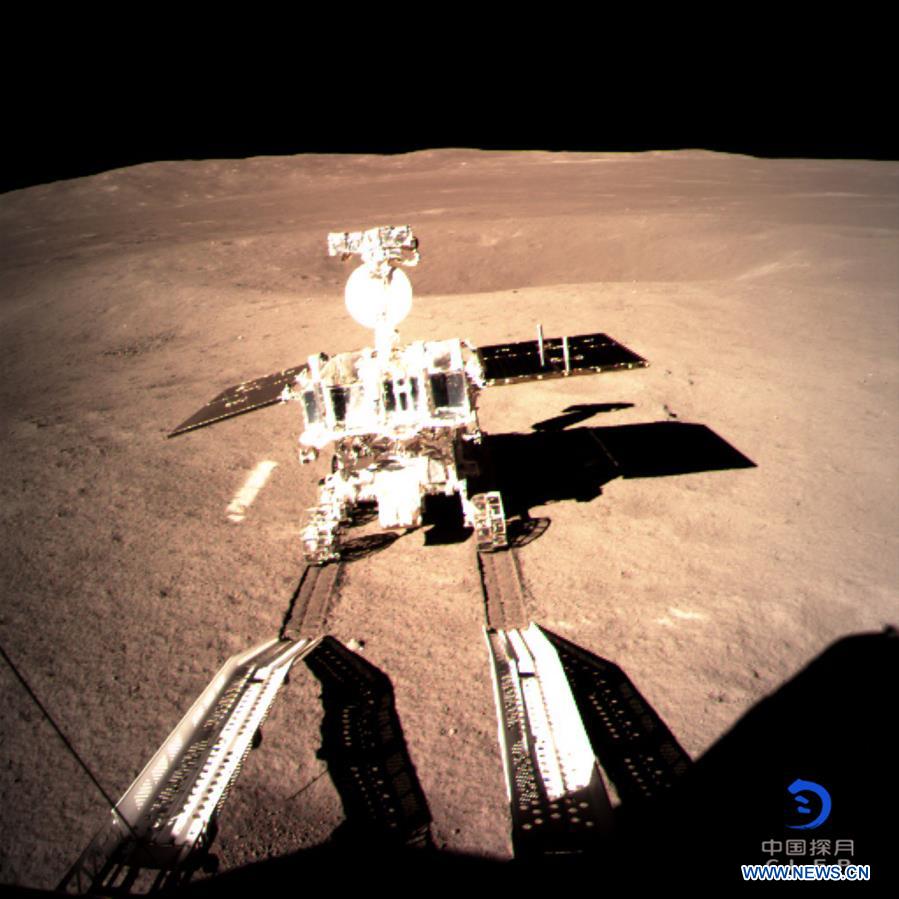
Photo provided by the China National Space Administration on Jan. 3, 2019 shows Yutu-2, China's lunar rover, leaving a trace after touching the surface of the far side of the moon. China's lunar rover, Yutu-2, or Jade Rabbit-2, left the first ever "footprint" from a human spacecraft on the far side of the moon late at night on Thursday, after it separated from the lander smoothly. The process was recorded by the camera on the lander and the images were sent back to the Earth via the relay satellite "Queqiao", the China National Space Administration (CNSA) announced. Launched on Dec. 8, 2018, China's Chang'e-4 lunar probe, comprising a lander and a rover, landed on the far side of the moon on Thursday morning. (Xinhua)
BEIJING, Jan. 6 (Xinhua) -- China's Chang'e-4 probe has started the exploration on the far side of the moon thanks to the relay satellite that provides a communication link with ground control.
The relay satellite, named Queqiao, meaning Magpie Bridge, after a Chinese legend, was launched on May 21, 2018, and became the first communication satellite operating in the halo orbit around the second Lagrangian (L2) point of the earth-moon system, nearly 500,000 km from the earth.
The maximum distance between the satellite and the Chang'e-4 probe on the far side of the moon is 79,000 km. The satellite processes data from the probe and transmits it to earth, said Sun Ji, a designer of the satellite from the China Academy of Space Technology.
The satellite can stay in its orbit for a long time due to its relatively low fuel consumption, as the earth's and moon's gravity balances its orbital motion, said Zhang Lihua, chief designer of the satellite.
While in orbit, it can "see" both the earth and the far side of the moon. From earth, the orbit looks like a halo on the moon, said Zhang.
The concept of deploying a relay satellite in the halo orbit was first put forward by U.S. space experts in the 1960s, but was realized by Chinese space engineers.
"We will let Queqiao work as long as possible. It could also provide communication for probes from other countries if they intend to explore the moon's far side within the lifetime of the satellite," said Ye Peijian, an academician of the Chinese Academy of Sciences and a senior space expert.
"And that will be a Chinese contribution made to the world," Ye said.
The relay satellite will also be used for scientific and technological experiments.
It has a low-frequency radio spectrometer, jointly developed by Dutch and Chinese scientists, to help astronomers "listen" to the deeper reaches of the cosmos.
It also carries a reflector developed by the Sun Yat-sen University, in south China's Guangdong Province, to conduct the world's longest laser-ranging test between the satellite and an observatory on the ground.
Researchers hope to use the cameras on the satellite to capture asteroids hitting the far side of the moon, said Sun Ji.
"It's extremely difficult, but we hope to try," Sun said.
To control the cost of the Chang'e-4 mission, the relay satellite was designed to be relatively small, weighing about 400 kg.
Chinese experts designed several antennas for it, including one shaped like an umbrella with a diameter of almost 5 meters.
"We learned from textile technologists and watchmakers in the development of the metal mesh and ribs on the antenna," Zhang said.
"It must endure temperature changes of more than 300 degrees centigrade. We conducted countless experiments for that."
His team had just 30 months to develop the satellite, putting them under tremendous pressure.
To promote public interest in space exploration, the China National Space Administration invited people to write down their wishes for lunar and space exploration, and the relay satellite carries the names of tens of thousands of participants and their messages.