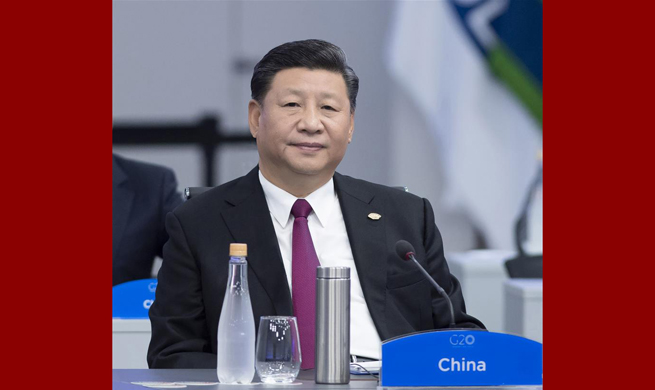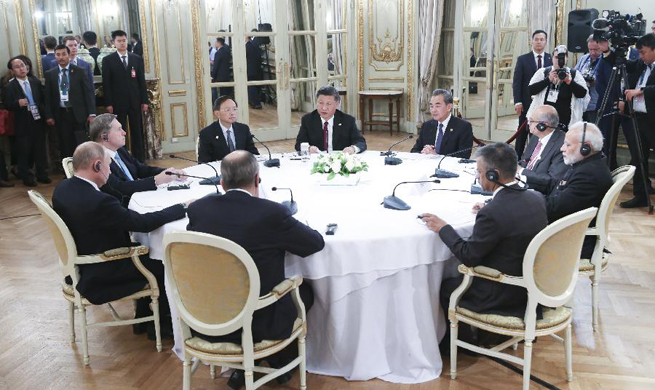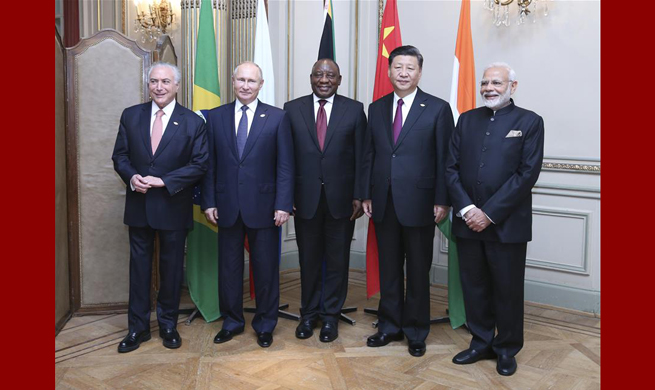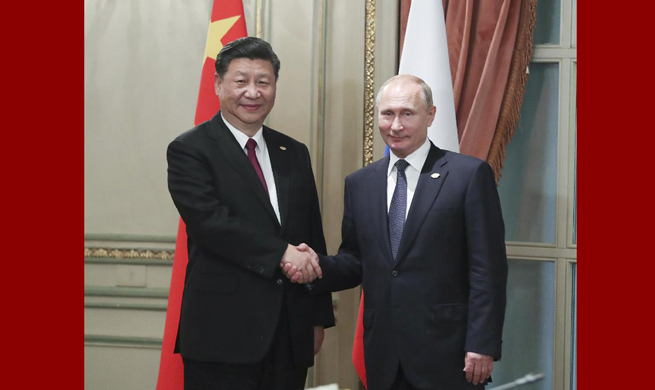
LONDON, Dec. 1 (Xinhua) -- As world leaders gather in Argentina for a G20 summit, expectations are running high that the world's major economies will take decisive measures to protect global growth amid the spectre of protectionism.
BACKING FREE TRADE
Over the past years, the G20 has proven a great help in the coordination of economic policies. The bloc of major economies is in Buenos Aires to find itself at the center of a multilateral trading system threatened by rising protectionism.
"The world is at a bit of crossroads in terms of continuing with globalization, putting right the mistakes or moving towards a more protectionist approach. There are lots of responsibilities that now lie on the shoulders of the G20 to find solutions and ways forward," said Stephen Perry, chairman of Britain's 48 Group Club.
Irene Mia, of the Economist Intelligence Unit (EIU), noted that trade is at the bottom of all questions. "Free trade is the key of fueling the growth we have seen but there may be setbacks. I am fairly optimistic in the long term."
Alan Barrell, professor at Cambridge Judge Business School, lauded China's consistency and determination in pursuing common development and advancing globalization.
He questioned the anti-globalization actions taken by some countries, which he said are "going a very wrong direction" and "in a way closing the door and stopping the trade." "Protectionism eventually brings bad things ... It always shows to be bad in the long run," he said. "Trade wars are never won."
PROTECTING GROWTH
In Hamburg in 2017, G20 leaders agreed to promote greater inclusiveness, fairness in the pursuit of economic growth and job creation. Argentina is expected this year to continue to steer discussions towards inclusive growth under the theme Building Consensus For Fair and Sustainable Development.
"There is a lot of discontent both in developed countries and developing countries. There is part of the population that thinks it hasn't been listened to by mainstream parties and the government. I think that growth hasn't been inclusive enough, so some parts of society are more vulnerable, as they haven't really profited by the growth we have seen in the past years," said Mia.
An EIU report said that mainstream political parties in the West were losing ground in recent years, as seen notably in Britain's 2016 referendum on Brexit and other European elections. Wealthy societies are more divided than once thought, according to the report.
In Mia's opinion, the top priority should be government building trust with people in order to secure the latter's constructive participation in the political process. For example, involving people in budget-making. "It is not just important to grow. It is actually important to grow in an inclusive way," she noted.
Observers said that it is vital to have inclusive development both within the country and around the world. The problem is how wealth and jobs are shared in a globalized world.
During the Chinese and German presidency of the G20 in the last two years, the group demonstrated a stronger commitment to increasing support for countries in Africa in sectors such as infrastructure, industrialization and agriculture.
"The sharing of the benefit of globalization hasn't been fair," Perry said, adding that several countries in Africa, Asia and South America have been sidelined in some respects.
IMPROVING INFRASTRUCTURE
In nations rich and poor, infrastructure upgrading is needed to boost growth and create jobs. However, the sector is underfunded, with a global gap of some 5.5 trillion U.S. dollars from now to 2035.
Argentina's G20 presidency is expected to prioritize infrastructure development, including mobilizing private investments.
"Three to five years ago, British newspapers were criticizing China for investing in infrastructure. Now you read that most economists recognize you cannot have long-term, even medium-term growth without investment in infrastructure," Perry said, calling the China-proposed Belt and Road Initiative (BRI) infrastructure friendly.
"The Belt and Road Initiative is transformational because it's transnational, so infrastructure development under the framework can become more inclusive in development. China is the only country that has the finance, skills and experience to do that," he said.
"Five years on, the initiative is still quite new," said Peter Frankopan, professor of global history at Oxford University. "A very large amount of money has been committed into projects right across Asia and also Africa since 2013. The initiative has no geographical limits and there are many cases where these investments are sensible, logical and work very well."
"What the Belt and Road Initiative can do in a positive way is to invest in very large infrastructure projects like energy plants, roads or train lines or ports that can have a very positive impact," Frankopan added.
In many of the countries where such investments are headed, there is an opportunity for a real improvement in gross domestic product as well as in the quality of people's lives, noted the historian.