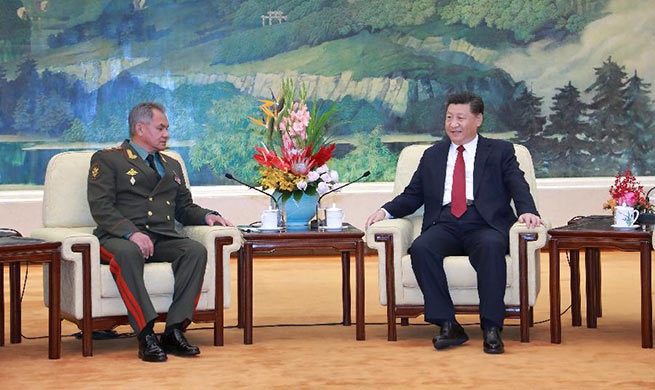
ROME, Oct. 19 (Xinhua) -- Italy suffered another rocky day on the financial markets Friday, as European Economic and Financial Affairs Commissioner Pierre Moscovici wound up the second day of a two-day visit to Rome during which he delivered a letter from the European Commission to Finance Minister Giovanni Tria asking him for clarification on Italy's draft budget.
According to the version published by the Ministry of Finance earlier this week, Italy's draft budget introduces a basic income for the poor of 780 euros a month, a "citizens' pension" of 780 euros a month, to be paid for mostly by deficit spending equal to 2.4 percent of gross domestic product (GDP). It also introduces a 15 percent flat tax for small businesses.
The deficit spending plan set Italy on a collision course with the European Union (EU) and sparked claims from the leftist opposition that the real intention of the new rightwing-populist government is to drive the Mediterranean country out of the eurozone.
This was reinforced when news broke late in the day that Moody's ratings agency had downgraded Italy's credit to Baa3 from Baa2, citing "significantly higher budget deficits planned for the coming three years compared to earlier expectations" and an increased possibility of an Italexit "should tensions between the Italian government and European authorities continue to escalate," the Financial Times newspaper and Italian news agency ANSA reported.
"No Europe without Italy, no Italy without Europe," Moscovici tweeted on Friday after meeting with Italian Foreign Minister Enzo Moavero Milanesi.
In a joint press conference with Tria on Thursday, Moscovici was at pains to stress that "the European Commission is not Italy's enemy" and that its purpose is not to criticize the ways in which eurozone members decide to spend money, but rather to make sure that each country plays by the rules that everyone has agreed to.
After all, if one eurozone member defaults, the others may have to step in to bail them out, as happened with Greece in 2010.
In an Oct. 15 report, the Bank of Italy said that at the end of 2017, the nation's public debt stood at 2.26 trillion euros, or 131.2 percent of gross domestic product (GDP). According to ISTAT national statistics agency, Italy's 2017 GDP amounted to 1.7 trillion euros (+1.6 percent over the previous year).
This means that Italy owes far more than it produces, and therefore it lives on borrowed money -- a fact that policymakers must deal with if they want to finance their budgets without alienating investors and driving the country into an economic tailspin.
However on Friday, the news on financial markets spelled trouble for Italy: the spread between Italy's benchmark 10-year government bonds and their German counterparts -- a key measure of investor confidence in the country -- jumped to 340 basis points in morning trading before ending the day at 301 points.
For comparison, the spread hovered at 130 basis points in March, just before a national election which ultimately produced the current euroskeptic coalition government that was seated in early June.
The bigger the spread, the lower the investor confidence and the higher the interest rates the country has to pay to borrow money.
Also on Friday, the European Central Bank reported that in August this year, foreign investors sold off 17.9 billion euros' worth of Italian sovereign bonds and company stocks -- another sign of waning confidence in Italy's ability or willingness to repay its debts.
Critics of the government's draft budget -- which so far include Italy's Parliamentary Budget Office (UPB), Confindustria industrialists association, the International Monetary Fund (IMF), and several EU countries -- argue that heavily indebted Italy cannot afford to spend money it does not have, that the budget is based on overly optimistic assumptions about future economic growth, and that it does not allocate enough to public investments.
"Real GDP is expected to grow by 1.5 percent in 2019, 1.6 in 2020 and 1.4 in 2021," according to Tria's draft budget. "Employment will grow on average by 1.1 percent per annum over the 2019-2021 period, and the unemployment rate is projected to decline to 8.6 percent in 2021 (from about 10 percent currently)".
However, these forecasts run counter to those of the Bank of Italy, the European Commission, and the Organisation for Economic Co-operation and Development (OECD) as well as Fitch and Standard & Poor's ratings agencies, all of which see Italy's economy slowing down to around 1.1 percent in 2019.
Writing on La Stampa newspaper on Friday, leading Italian economist Carlo Cottarelli said that the draft budget is a throwback to the 1970s and '80s, when Italy began racking up its huge debt because past governments used "the public deficit as a driver of growth".
Meanwhile, the Italian government is supposed to reply to the European Commission's letter on Monday. On Tuesday, the commissioners gather to examine the draft budgets of all the eurozone members, including Italy.