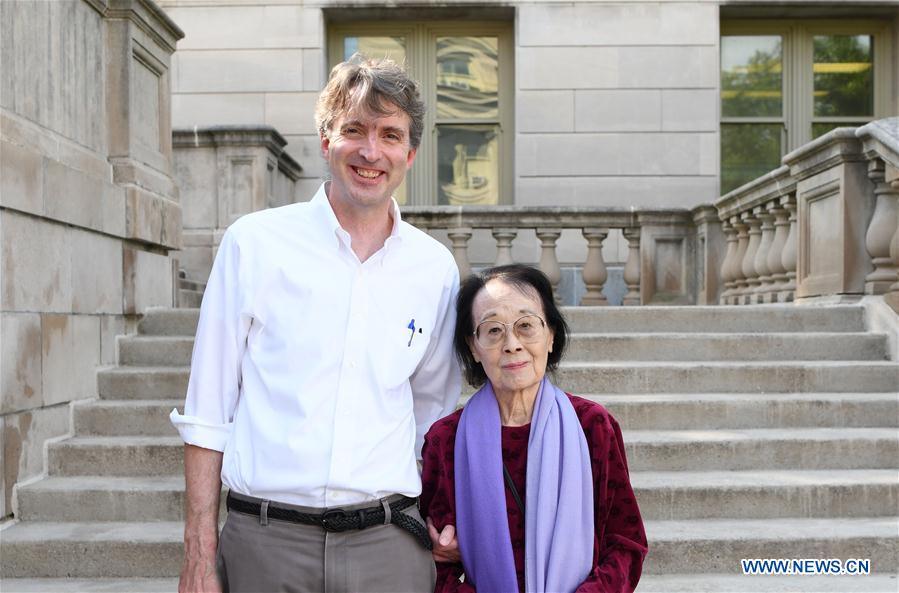
Novelist Nieh Hualing (R) and Hugh Ferrer, associate director of the International Writing Program, pose for photos in the city of Iowa, Iowa, the United States, on Sept. 17, 2018. Novelist Nieh Hualing, living in Iowa City for some five decades, has helped link the place with the image of lotus, which represents poetical peace and moral integrity in Chinese literature and has hence been widely adored in all ages. (Xinhua/Liu Jie)
IOWA CITY, the United States, Oct. 17 (Xinhua) -- Iowa has been called "Aihehua" (meaning "love the glamor of lotus") in Chinese, at least in the world of writers and poets.
Chinese novelist Nieh Hualing, living in Iowa City for some five decades, has helped link the place with the image of lotus, which represents poetical peace and moral integrity in Chinese literature and has hence been widely adored by all ages.
The UNESCO City of Literature has also been quite famed among those writing and speaking Chinese. For some 40 years, it has invited talented Chinese writers and poets to the United States for writing and talking with counterparts from other nations, giving them a rare chance of exposure when their country just opened up to the outside world.
PAUL ENGLE'S POEM
"A gray-haired wind has blown thousands of years. Red dirt from green fields into your brown eyes... The future is a rocket where you ride."
The verses were created by Paul Engle, a U.S. poet born and brought up in Iowa State, heart of the Midwestern region famous for its corn and hogs. A stranger to the Chinese language, he recorded his intense responses to several trips to China with his Chinese wife, Nieh, in the late 1970s, when the country began to conduct reforms and embrace the wider world.
So moved by his experiences in China that convinced him the country is ready to open up, Engle believed that the only possible reaction he could make had to be in poetry. "Images of China," a poetic collection of his thoughts on China, was filled with rimed stanzas, blank verse, the sonnet, free verse unrimed, rimed couplets, all verse forms in English.
The trips to China have also partly explained the couple's commitment to the International Writing Program (IWP), a writing residency for international writers and poets in Iowa City.
According to Hugh Ferrer, the IWP's associate director, the exchange program, since its inception in 1967, has provided a period of optimal conditions for the creative work of nearly 50 emerging and established Chinese poets and novelists, in a bid to grasp the momentum of Chinese modern literature and enhance bilateral literary communication for better understandings.
"During my first time coming back to China, I met with Wang Meng, Bing Xin and Ai Qing, as I wished. I was so happy since I knew that means China was beginning to open up," recalled Nieh, who was born in 1925 in China's Hubei Province.
"I needed to know and invite the senior writers, I needed to know and meet the young ones, I needed to know what had happened in the past and what would happen then for this country."
Noticeably, most of them were invited after China's reform and opening up. They were household names, even globally famous, like Nobel laureate in Literature Mo Yan.
For most of them, the stay in Iowa City became their first ever experience outside China. Their exposure to the agricultural, U.S. heartland city, to some extent, altered their general imagination of the United States that had come mostly from movies and books.
However, the culture shock has been a rare experience for young Chinese attendees after the year 2000. China had become an integral part of globalization by then, lessening their curiosity on one hand and enabling more proactive participations on the other.
Chinese poet and mathematician Cai Tianxin, also this year's invitee, told Xinhua that he had been invited to give lectures in 11 U.S. cities during the three-month stay.
A WINDOW BETWEEN U.S.- CHINA
The program has been well connected with China since the beginning, thanks to Nieh. It has still been a window for Chinese writers to get across the literature genres in the United States and beyond.
For Su Tong who was invited in 2001, the exposure to the international family-like atmosphere impressed him most. For Bi Feiyu, an invitee in 2006, he learnt the importance of dialogue on equal footing in teaching literature through the program. But to Chi Zijian who participated in the program in 2005, the subjects of the IWP's panel discussions, such as gender and writing, horror depicting, imagination and reality, had all been inspiring to her writing.
"My colleagues come from different parts of the world with different cultural backgrounds," Chi said. "Listening to their remarks is like building up a world with literature as nation's boundary."
On the other hand, the involvement of Chinese writers, seen as "the source of peace and dialogue," has been a treasure for the IWP. The activities related to China have been booming.
"We've hosted a lot of really interesting writers here and Chinese writers in particular. I can say without reservation that Xi Chuan's poems have shaped my own thinking as a poet, the novels of Mo Yan and Su Tong have profoundly influenced my understanding of contemporary Chinese life. To be a writer in the 21st century, you have to have some sense of what China is all about," said IWP's director Christopher Merrill.
"There are many windows for us Chinese writers to look through to the outside world, but the one in Iowa has still been the largest and brightest one, leading us to the world stage," Chi noted. "The most positive part of the IWP is to get us, through literature, to the world peace that we have dreamed of for long."
A LIFE-LONG BOND
1104 North Dubuque Street stands a hillside pink-colored two-story building with a discolored plate, which reads "Engle's House."
The house, for decades, has been the most frequented place for Chinese writers coming to Iowa city. The host and hostess have been welcoming and caring, helping promote them in the U.S. literary circle and launching fund-raisings to pay for their flights and daily necessities so that they could get tuned to the life in a country so different from theirs.
The friendship between the Engle couple and Chinese writers has been personal and enduring, said He Jixian, an analyst from Chinese Academy of Social Sciences.
He said that Nieh and Engle have captured the worthy part of Chinese modern literature after China's reform and opening up, such as the genres and talented writers.
"Nieh has also been inspiring to the narrative of China's stories in the 20th century," he said.
"The writers she likes to invite are adept at telling the stories and emotions of the Chinese in key turning points of the country's history. Now that China has had a booming economy, it is high time for writers to tell the stories happening in the country in the past century. It's about China's cultural identity. It is important," he said.?