




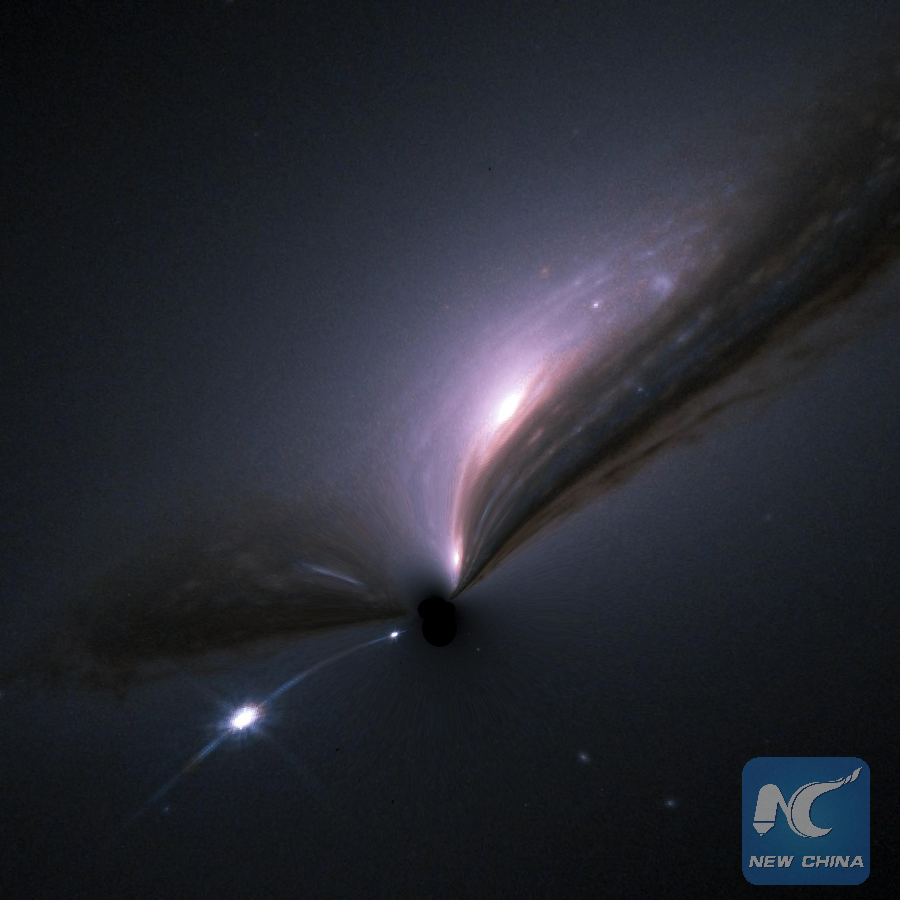
A supernova (bright spot at lower left) and its host galaxy (upper center), as they would appear if gravitationally lensed by an intervening black hole (center). The gravitational field of the black hole distorts and magnifies the image and makes both the galaxy and the supernova shine brighter. Gravitationally magnified supernovas would occur rather frequently if black holes were the dominant form of matter in the universe. The lack of such findings can be used to set limits on the mass and abundance of black holes. (Credit: Miguel Zumalacárregui image, UC Berkeley)
WASHINGTON, Oct. 2 (Xinhua) -- Physicists still cannot tell what exactly the dark matter is, but now they know more about what it is not. It is not black hole, according to a study published on Tuesday in the journal Physical Review Letters.
Astronomers once proposed the universe's mysterious dark matter might consist of a plenitude of black holes sprinkled throughout the universe, especially after the 2015 LIGO detection of gravitational waves from colliding black holes.
Physicists from University of California, Berkeley dashed those hopes, however.
They conducted a statistical analysis of 740 of the brightest supernovas discovered as of 2014, finding that none of them appeared to be magnified or brightened by hidden black hole "gravitational lenses."
Therefore, the researchers concluded that primordial black holes could make up no more than about 40 percent of the dark matter in the universe.
Primordial black holes could only have been created within the first milliseconds of the Big Bang as regions of the universe with a concentrated mass tens or hundreds of times that of the sun collapsed into objects a hundred kilometers across.
The results suggest that none of the universe's dark matter consists of heavy black holes, or any similar object, including massive compact halo objects, so-called MACHOs.
Dark matter is one of astronomy's most embarrassing conundrums: despite comprising 84.5 percent of the matter in the universe, no one can find it.
An unseen population of primordial black holes, or any massive compact object, would gravitationally bend and magnify light from distant objects on its way to Earth, according to the study.
Therefore, gravitational lensing should affect the light from distant Type-Ia supernovas. These are the exploding stars that scientists have used as standard brightness sources to measure cosmic distances and document the expansion of the universe.
The paper's lead author Miguel Zumalacarregui at the Berkeley Center for Cosmological Physics conducted a statistical analysis of data on the brightness and distance supernovas and concluded that eight should be brighter by a few tenths of a percent than predicted based on observations of how these supernovas brighten and fade over time. However, no such brightening has been detected.
"What was intriguing is that the masses of the black holes in the LIGO event were right where black holes had not yet been excluded as dark matter," said Uros Seljak, a University of California Berkeley professor of physics.
"That was an interesting coincidence that got everyone excited. But it was a coincidence," said Seljak.