SHIJIAZHUANG, Aug. 16 (Xinhua) -- After over 30 years of hard work in the potato industry, Wang Dengshe has risen from an entry-level researcher to the CEO of one of the leading potato companies in the country, yet he still spends most his time in the field or the laboratory.
"I felt like it was my destiny to enter the potato industry," 55-year-old Wang said, "I knew from the very beginning that innovation will always be the core of the job."
Wang graduated from a technical school in 1981, three years after the country's reform and opening up drive began. Agricultural research institutes were looking for some young talent and Wang took a job as a researcher instead of returning to his hometown to become a farmer.
Wang now has a potato company with an annual revenue of about 800 million yuan (116 million U.S. dollars). "None of this would have been possible without the new policies and great timing of that era," he said.
After three years of researching soils and fertilizers, Wang joined the potato research team.
Working at the research institute, Wang learned about planting potatoes and developing new varieties, and the importance of converting the achievements of scientific research into productivity.
SUPPLYING MCDONALD'S
It wasn't until the late 1980s that foreign food chains began to enter the Chinese market. In 1990, the first McDonald's franchise opened in the southern coastal city of Shenzhen, and two years later, the fast-food chain came to downtown Beijing.
Burgers and French fries were welcomed by Chinese people, but few know the story behind the potatoes the company used.
"We didn't grow the right kind of potato that McDonald's required back then," said Wang, "Their foreign potato seeds couldn't grow in China."
As the country with the largest potato output, China had to import about 50,000 tonnes of potatoes to meet the needs of McDonald's.
We were focusing on developing high-yield and disease-resistant potatoes, the quality and shape of the local potatoes were far behind the standard required to make frozen fries, Wang recalled.
In 1982, McDonald's sent a team to China to find the right potato and the following year sent U.S. potato experts who tried to plant new potato varieties, including "shepody," the most popular potato used for French fries in North America.
This was the first time Wang worked with foreigners. He was surprised, and at the same time inspired, by their advanced technologies and ideas. "I wanted to work on a bigger scale," he said.
In 1995, Wang left his secure job and joined the Beijing Office of J.R. Simplot, the supplier of MacDonald's fries. He saw foreign experts come and go, and at the end of the 1990s, the plan to plant shepody potatoes in China was almost suspended.
"There was a gap between the foreign advanced ideas and the Chinese reality. Some of the equipment and the components that foreign experts wanted were almost impossible to find back then," Wang said.
Wang observed and learned, and decided to try planting shepody potatoes by himself.
"With some innovation and adjustment, I believed I could bring the idea and reality together, and make it happen," said Wang. In 1999, he led a team of researchers from the agricultural science research institute he previously worked for and started his own experiments.
After four years, Wang finally found the way to establish shepody down in China. J.R. Simplot was thrilled, and Wang's name became well-known in the industry.
DREAM BIGGER
Wang's potato dream didn't stop there.
"The industry was expanding. I wanted to go out and do more," Wang said, "I will always be grateful to J.R. Simplot. It broadened my horizons and let me know that I can achieve more."
At the beginning of 2007, with a start-up fund of 10 million yuan, Wang and a few friends set up their company, Snow Valley Agricultural Development Co., Ltd., in Zhangjiakou, Hebei Province, a leading potato planting, production, and processing base.
Over the last decade, the company grew from a small potato supplier with only a couple of employees and revenue of less than 10,000 yuan, to an industry giant with an annual revenue close to 800 million yuan.
Wang continued his pursuit of innovation over the years. Since 2008, his company has developed 28 new potato varieties. They spent 120 million yuan to build a potato research center last year, the first such center opened by a Chinese company.
More foreign capital and products flowed into China after the country joined the WTO in 2011. This brought both challenges and opportunities and the domestic potato industry was forced to grow faster, Wang recalled.
In 2014, Snow Valley partnered up with Aviko, one of the four largest potato processors in the world. New processing lines were opened with a total investment of more than 600 million yuan from both sides.
The company can turn a raw potato into a box of semi-finished French fries in just about an hour. About 7.5 tonnes of potatoes are washed, peeled, cut, and fried every minute.
The Ministry of Agriculture said in early 2016 that the country will further boost potato production to make the tuber one of the nation's staple foods. By 2020, China will have more than 6.67 million hectares of potato planting areas, 30 percent of which can be processed into staple food.
"Promoting potatoes as a staple food has made our customers realize the importance of the potato and the rich nutrition it contains. It's good for the whole industry," Wang said. "Once again we have enjoyed the benefits of the latest government policy."
GIVING BACK
Growing up in an ordinary family in Zhangbei county, Wang never forgot where he came from. No matter how much money he earned and how big his business grew, he always likes to call himself a farmer.
"I have tried to help local farmers as much as they helped me," said Wang.
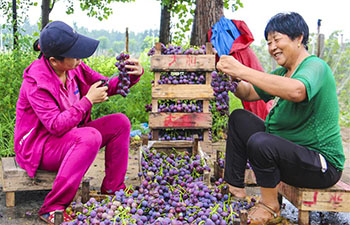
Villagers living in the Chabei area changed as Snow Valley grew. The company has been hiring local farmers to grow potatoes since its establishment. They taught the farmers harvesting techniques and supplied them with seeds and equipment, and offered to pay the rent for the lands they manage. More than 700 locals have been employed by the company, and another 4,000 are hired during the harvest season.
Meanwhile, Snow Valley has built potato planting bases in several impoverished counties in Hebei Province and the north Inner Mongolia Autonomous Region, providing a stable income for more than 20,000 households living under the poverty line, the company said.
"I've been successful by following the industry trends and the government's policies, " Wang said. "But we need to stay vigilant at all times."
China is the world's largest potato producer with a planting area of around 5.6 million hectares, one quarter of the world's total, but we do not receive the market shares equal to our output, Wang said.
Wang is determined to keep expanding and strengthening his business in the domestic market over the next few years and is ready to tackle the overseas market.
"I believe there's much more we can do," Wang said.