

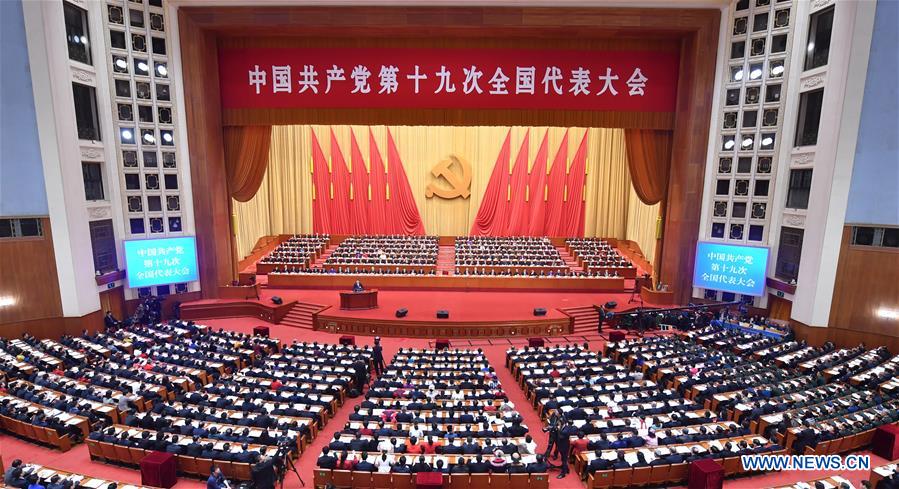
Xi Jinping delivers a report to the 19th National Congress of the Communist Party of China (CPC) on behalf of the 18th Central Committee of the CPC at the Great Hall of the People in Beijing, capital of China, Oct. 18, 2017. The CPC opened the 19th National Congress at the Great Hall of the People Wednesday morning. (Xinhua/Li Tao)
By Xinhua writers Zhang Zhengfu, Liu Jie, Wang Xiuqiong
BEIJING, Oct. 23 (Xinhua) -- "The middle income trap" is a recurring concern in developing countries and was once a serious worry for China.
The concept was first put forward by the World Bank in a 2006 report on East Asian economies. The theory is that in middle-income economies, growth slows, nations are unable to generate further economic impetus and per capita GDP stalls.
Japan, the Republic of Korea and Singapore are among a few that have attained high-income status. Most Latin American countries have fallen into the trap, according to World Bank standards.
STEPS TO SAFETY
Through the economic reforms of the past five years, China has seemed more likely to escape the trap.
The wide-ranging reforms Xi Jinping set out in his report to the ongoing 19th National Congress of the Communist Party of China (CPC) on Wednesday will make China even more capable of avoiding the trap, said Liu Yuanchun, an economist and vice-president of Renmin University of China.
The CPC leader dealt with the core problems facing the economy which might stagnate growth and pledged to continue supply-side structural reform, enhance risk control, improve macro regulation, ease market access and boost innovation, said Liu.
Xi spoke of focusing on the real economy, and moving industries up to the medium-high end of the global value chain, and laid out plans to make China a country of innovators.
China will introduce a negative list for market access nationwide and support the growth of private businesses, Xi said, adding that China will significantly ease market access and further open the service sector.
Xi also said China will improve the financial regulatory system to "forestall systemic financial risks." On reform of the state-owned enterprises (SOEs), he called for furthering reform and supporting state capital in "becoming stronger, doing better, and growing bigger."
"I think it will be no problem for China to avert the middle-income trap, and we should be confident about this," Liu told media on the sidelines of the congress.
BUILDING ON SOLID GROUND
Liu's confidence stems from the solid foundation of the economy and the goals the Party has set.
While announcing socialism with Chinese characteristics has entered a "new era," Xi envisioned China developing into a nation with "socialist modernization basically realized" by 2035, and "a great modern socialist country" by the middle of the century, with a leading influence in the world.
An immediate goal would be to turn China into a "moderately prosperous society" by 2020, doubling GDP from 2010 levels.
Optimism has been building due to the resilience of the economy. GDP has risen by around 26 trillion yuan (about 3.93 trillion U.S. dollars) in the past five years and is well on track to meet this year's growth target of about 6.5 percent.
NEW-FOUND CONFIDENCE
The middle-income trap is what happens when economic stability becomes economic stagnation. The World Bank estimated in 2012 that of 101 middle-income economies in the 1960s, only 13 became high-income ones in 2008.
After the global financial crisis, fears grew that China might be the next victim. Growth slowed after three decades of unprecedented expansion, slipping to 6.7 percent in 2016, the lowest level in over 20 years.
Lou Jiwei, then finance minister, warned at a forum at Tsinghua University in 2015 that, without further reform, China had a "50/50 chance" of sliding into the middle income trap, citing a rapidly aging population and shrinking labor force.
Lou, also a delegate to the 19th CPC National Congress, updated his verdict Thursday.
"Now I can state with full confidence that, after the sweeping reforms of the past two and a half years, it will be no problem for China to avoid the middle income trap," he said on the sidelines of the congress.
The ex-minister, currently head of the National Council for Social Security Fund, credits his optimism to supply-side structural reform, granting household residency to migrant workers, reduced government restrictions, judicial reform and free trade zones.
FIGHTING ON EVERY FRONT
Despite all this optimism, it is still too early to announce that the middle income trap has been well and truly evaded.
The World Bank classifies economies as low, middle or high income. Middle-income nations are those with a per capita gross national income (GNI) between 1,036 and 12,615 U.S. dollars in 2012. China's per capita GNI was 8,260 U.S. dollars in 2016, 93rd in the world.
Liu of Renmin University of China expected China to be a high-income country by 2030, but admitted that this would not be an easy task.
"Transforming the economy will not happen overnight. We must wait for these new, leading industries to become established and take the economy to the next level," said Huang Yiping, an economist with Peking University.
Innovation is another front. A recent UBS research paper said that, "in order to avoid the middle income trap and become a more developed economy, China will have to transform itself from 'made in China' to 'created in China' -- a route backed strongly by Beijing."
"Already a middle income economy, China cannot overcome the trap by simply relying on structural reforms and expanding domestic consumption," said Edmund Phelps, a Nobel Prize-winning American economist. "Rather, China needs to develop and promote its own approach to technological innovation."
?