New five-year plan gives China's frontier regions bigger role in modernization drive


BEIJING, March 14 (Xinhua) -- When China unveiled its new five-year plan running from 2026 to 2030, phrases like AI, computing power and "smart economy" buzzed via news feeds. However, they tell only part of the story.
Running through this plan is another important thread. China's vast frontier regions have assumed a more prominent role in the national masterplan to build a unified domestic market, strengthen energy security and expand opening up.
This emphasizes that the Chinese modernization endeavor is aimed at securing prosperity for all. Analysts say by featuring in core sections on transport, energy, digital infrastructure and regional integration, these frontier regions are being closely woven into China's modernization tapestry.
"The strategic importance of Xinjiang, for instance, is heightened," said Zhang Bin, a national political advisor and deputy director of the Institute of World Economics and Politics at the Chinese Academy of Social Sciences. "With its location, resources and industrial base, it can serve as a key hub in China's broader opening up."
The plan calls for continued expansion of westbound freight train services and accelerated development of port infrastructure. In this autonomous region in northwest China, the China (Xinjiang) Pilot Free Trade Zone, the first in the country's northwest border regions, is expected to see accelerated growth over the next five years, thus further boosting westward trade flows.
Xinjiang saw a nearly 20 percent year-on-year increase in the total value of its foreign trade in 2025, ranking first in terms of growth rate among all Chinese provincial-level regions, hitting 520.37 billion yuan (about 75.34 billion U.S. dollars).
"Xinjiang's foreign trade rests on a solid foundation and holds vast potential, and is well positioned to maintain strong growth momentum during the 15th Five-Year Plan period," said Li Xuan, deputy director of the regional department of commerce.
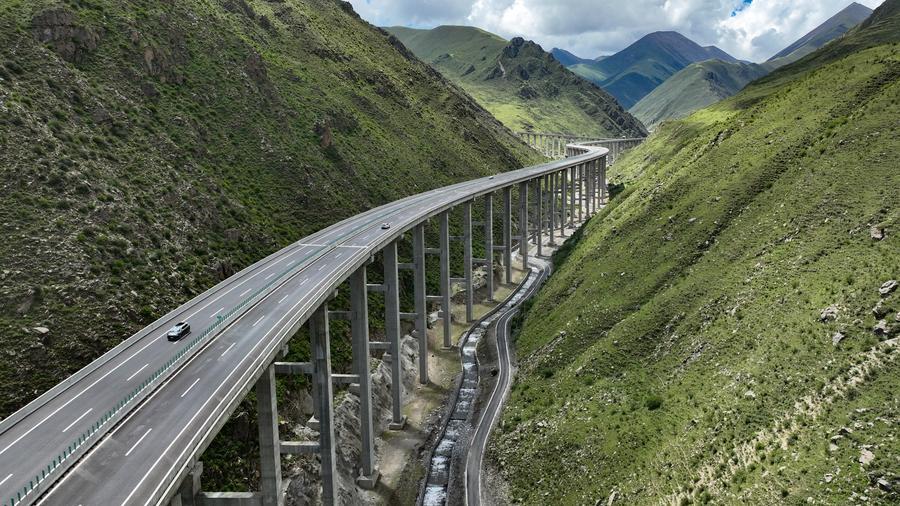
In the section on transport, the plan calls for stronger railways and feeder airports in western regions, better road networks in border areas, and improved cross-border transport connectivity.
"When more border area road networks are incorporated into national-level planning, it signifies the integration of frontier infrastructure into the country's broader transport system," said Penpa Lhamo, deputy director of the Xizang Academy of Social Sciences. "That is important for extending the unified domestic market across the full national space."
Over time, this approach could help generate more self-sustaining growth. In Xizang Autonomous Region, southwest China, new economic opportunities have already been generated. In the tourism hub of Nyingchi, improved infrastructure is giving apples and yak products access to wider markets, including through expanded highway links. Better roads are also bringing more visitors and allowing locally produced goods to reach consumers beyond the plateau.
During the 14th Five-Year Plan period (2021-2025), Xizang's regional GDP grew by 6.3 percent on average annually, reaching 303.19 billion yuan last year. The region is aiming for a GDP growth of more than 7 percent in 2026, and will expand its opening up at a higher level as a border region, according to the regional government work report.
The plan's energy strategy also propels these remote regions to the forefront of China's green energy expansion.
It calls for continued development of major new energy bases in Xinjiang, the upper Yellow River region and the Hexi Corridor, outlining new power transmission channels for clean energy bases in frontier regions including Xinjiang, Xizang and northwest China's Gansu Province.
West-to-east electricity transmission capacity is expected to exceed 420 million kilowatts by 2030, a crucial target year by which China has pledged to peak its carbon emissions.
Xinjiang's renewable energy sector, meanwhile, has been gathering momentum. During the 14th Five-Year Plan period, Xinjiang's installed new energy capacity had reached 169 million kilowatts, accounting for 64 percent of the region's total installed power capacity.
"Xinjiang, no longer defined only by its role as a major energy and resource base, is becoming an important pillar in China's green transition," said He Mingxing, a senior scholar at Xinjiang University.
The 15th Five-Year Plan period (2026-2030) is expected to inject further momentum into the region's green power development.
Beyond transportation and energy, the plan calls for expanding digital infrastructure into frontier regions, including national data networks, satellite internet and wider broadband coverage.
In the southwestern inland province of Guizhou, mountain caves are now being repurposed as data storage centers. The region, previously one of China's poorest, is capitalizing on the country's "East Data, West Computing" strategy, which channels data-hungry computing tasks from eastern coastal cities to the resource-rich west. This model delivers investment and jobs to mountainous areas like Guizhou, while leveraging local natural advantages for energy-efficient cooling.
In terms of public services, the plan urges more investment in education and healthcare in border areas, pointing to a shift from scattered projects toward more integrated public service systems.
The benefits of such investment are already visible in places like Nujiang, formerly one of China's most impoverished regions in southwest China's Yunnan Province. Roads now extend along cliffs where only goats once passed. Bridges span deep gorges, connecting isolated mountain villages to the broader landscape. Drones navigate canyons, delivering mail and supplies, while internet connectivity and e-commerce platforms have begun linking remote communities to the national market.
Observers believe that the new five-year plan is likely to produce more such opportunities.
"China is not choosing between a high-tech future and frontier development," said Yang Fuqiang, head of the Institute of Sociology at the Xinjiang Academy of Social Sciences. "It is bringing the two together, making the frontier an integral part of its modernization drive." ■







Comments