Xinhua Headlines: EU strategic autonomy tested by external pressure, internal rifts

*Frictions between the EU and the United States escalated throughout 2025 and persisted into the year-end.
*The EU's longstanding internal fractures worsened in 2025, as the surge in far-right movements across the bloc hamstrung supranational cooperation under EU governance.
*Beset by both external and internal challenges, the EU tried to take more initiatives and seek alternative partners to find a glimmer of hope.
ROME/BRUSSELS, Dec. 27 (Xinhua) -- Under the glow of Christmas lights across European capitals, Europe headed into the year's final stretch with a clearer sense of how much 2025 had reordered its realities.
The year was marked by intensifying transatlantic frictions, widening policy splits among EU member states, and constrained efforts to diversify partnerships beyond the bloc, placing Europe's pursuit of strategic autonomy under sustained strain and turning 2025 into a watershed year for the bloc.
MOUNTING TRANSATLANTIC STRAINS
Frictions between the EU and the United States escalated throughout 2025 and persisted into the year-end. On Wednesday, the United States sanctioned European individuals, seen by analysts as the latest move in retaliation for the EU's fines on U.S. tech companies.
In trade talks, the EU made sweeping concessions, cutting a deal that European Parliament Vice-Chair Kathleen Van Brempt denounced as "neither fair nor balanced."
The U.S. threat to withdraw security guarantees has imposed heavy burdens on the EU's strategic autonomy. Under pressure, members of the NATO military alliance, which are mostly based in Europe, had to agree to drastically increase defense spending at the NATO summit, a target that critics have questioned as unrealistic. Simultaneously, the EU struggled to fill the financing gap for Ukraine as the United States pulled back from providing substantial military aid.
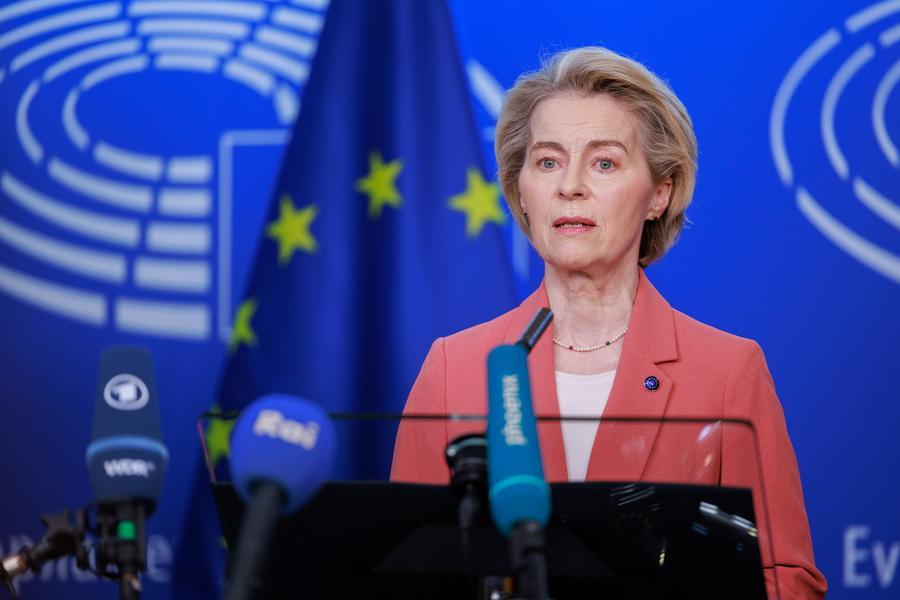
Values and diplomatic tensions peaked as the U.S. National Security Strategy (NSS), released in December, assessed the EU with unprecedented negativity, claiming Europe faced a "civilizational erasure" and an erosion of "political freedom and sovereignty." The U.S. NSS then stated it aimed to "help Europe correct its current development trajectory," a claim interpreted by Europeans as a license for political interference.
Renewed talks of "purchasing Greenland" further shocked Europeans. The appointment of a new U.S. special envoy to Greenland prompted immediate pushback from Denmark and the EU, reinforcing anxieties over borders and territorial integrity.
Max Bergmann of the Center for Strategic and International Studies, a U.S. think tank, commented, "This is sort of like a divorce. Europeans do not want the marriage to end, but the United States made clear that it is over."
WIDENING INTERNAL RIFTS
The EU's longstanding internal fractures worsened in 2025, as the surge in far-right movements across the bloc hamstrung supranational cooperation under EU governance.
France and Germany, the bloc's traditional pillars, "are under immense pressure from the right and probably no longer control a political majority in their countries," noted Zarko Puhovski, a Croatian political analyst.
Observers said the lack of domestic stability has weakened their ability to coordinate, leading to a growing drift between the two. Divergences have since emerged on issues ranging from the recognition of a Palestinian state to cooperation with non-EU partners in the digital and military sectors, as well as delays to the EU-Mercosur trade deal.
The Financial Times reported that the widening divisions between Paris and Berlin do no good to the EU's unity, as many expect the two engine powers to help translate the bloc's vision into reality as they have in the past.
Member states remained divided on major policy initiatives. On the use of frozen Russian assets, the Baltic states pushed ahead, while Belgium raised objections. A separate plan for joint EU borrowing moved forward only after exemptions were granted to Hungary, Slovakia and the Czech Republic.
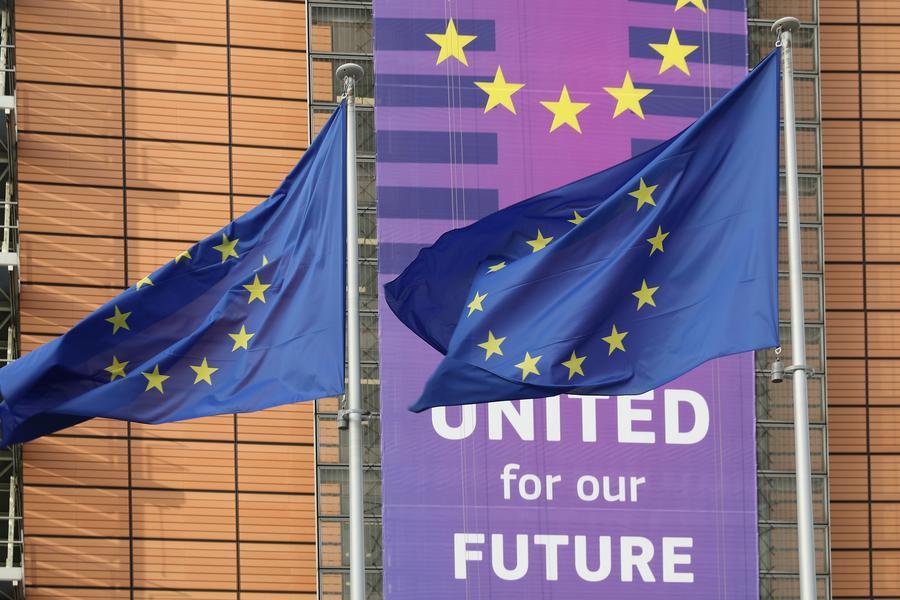
Divisions were also evident on defense and climate policy. Spain declined to raise defense spending to 5 percent of GDP as agreed at the NATO summit. On green transition, Germany and Italy pressed for easing the EU's 2035 zero-emissions target for new cars, prompting concerns from manufacturers and environmental groups that such adjustments would weaken regulatory credibility and the bloc's climate ambitions.
In her September 2025 State of the Union address, European Commission President Ursula von der Leyen stressed that her pitch is "a pitch for unity," strongly calling for unity between member states and between EU institutions.
Yet analysts doubted it. Bulgarian scholar Stanimira Daneva noted that the EU faces a significant lack of strong leadership, insufficient political unity and defense autonomy to function as an independent force.
Eberhard Sandschneider, a political expert at Berlin Global Advisors, told Xinhua that European unity is increasingly challenged by internal divisions, particularly between member states that differ in their approach toward U.S. political presence in European affairs.
The three countries excluded from joint debt for Ukraine have already signaled the trend, noted Puhovski. "Divisions within the EU cannot be overcome and will, in fact, deepen."
SEEK ALTERNATIVE PARTNERS
Beset by both external and internal challenges, the EU tried to take more initiatives and seek alternative partners to find a glimmer of hope.
Despite the mounting pressure from the U.S. "stick and carrots" strategy, EU officials defended digital sovereignty. Investigations and fines against Google, X and Meta continue.
The U.S. attitude touched a nerve in Europe, said former UN under-secretary-general Erik Solheim. "Only nations that stand up for their own interests and demonstrate self-confidence will be respected by Washington."
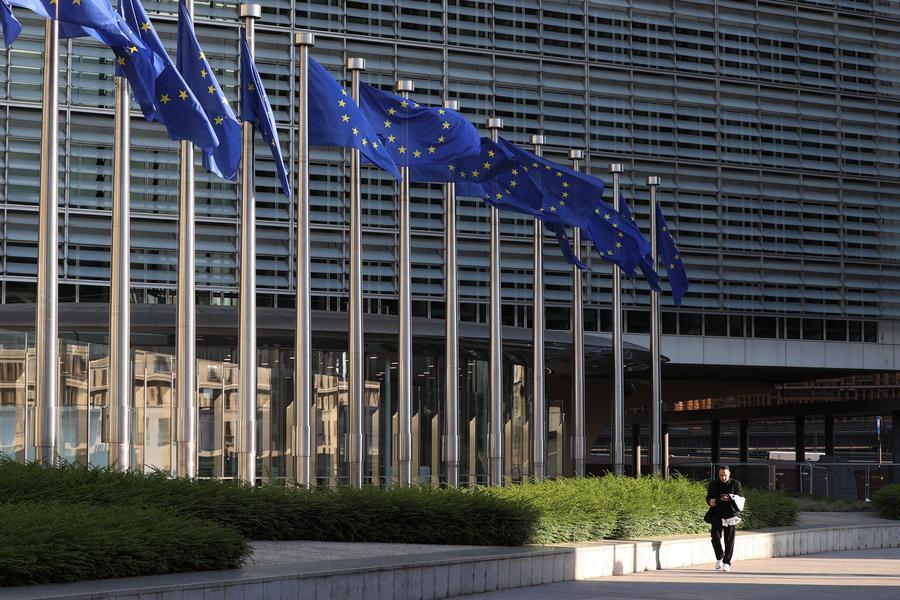
However, the primary obstacle to the EU's pursuit of strategic autonomy may not be digital sovereignty. According to Puhovski, Europe's dependence on U.S. military and intelligence capabilities has hindered the realization of a genuine strategic autonomy. He said, "The EU lacks autonomy at the very core of power."
At the fourth EU-CELAC (Community of Latin American and Caribbean States) summit in November, both sides pledged cooperation in research, innovation, digital alliances and energy transition. Observers see Latin America as a key market for the EU's Global Gateway initiative, with similar expectations in Africa.
However, when it comes to more urgent trade and investment needs, delays in the EU-Mercosur deal, driven by conflicts of interest among European farmers, cast a shadow on these ambitions.
Dan Krause, programme director for European and International Politics at Bundeskanzler-Helmut-Schmidt-Stiftung, a German think tank, told Xinhua that "Trump 2.0" is reinforcing the need for Europe to rely on international cooperation. But if Europe cannot ensure stability and growth on its own continent, it cannot credibly project these capabilities globally.
In 2025, leaders, including French President Emmanuel Macron, Spanish Prime Minister Pedro Sanchez, and King Felipe VI of Spain, visited China. Sanchez said that dialogue is always better than confrontation in trade disputes.
Solheim noted that these high-level exchanges signal a willingness between the EU and China to manage differences through dialogue, suggesting that stable EU-China relations could bring greater certainty to global geopolitics and trade.
(Video reporters: Yang Yating, Kang Yi, Ma Zhiyi, Liu Yuxuan and Ma Ruxuan; Video editors: Liang Wanshan, Li Qin, Cao Ying and Hui Peipei) ■







Comments