Feature: Unearthing Rock Springs' lost Chinatown brings to light forgotten chapter of U.S.

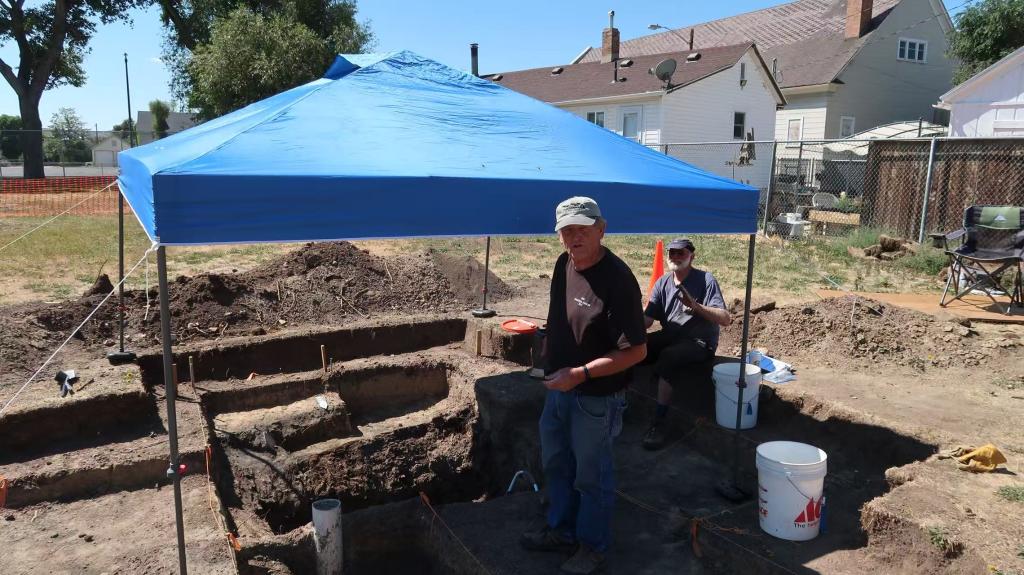
Dudley Gardner stands at the excavation site of Chinatown in Rock Springs, Wyoming, the United States, Sept. 2, 2025. (Photo by Huang Qian/Xinhua)
by Xinhua writers Yang Shilong, Shi Chun
ROCK SPRINGS, United States, Dec. 1 (Xinhua) -- In Rock Springs, a windswept Wyoming town once sustained by the Union Pacific Railroad, no one was ever held accountable for the 1885 massacre that decimated its Chinese community. Now, two archaeologists are digging for truth -- unearthing a lost history and restoring a stolen humanity.
THE GROUND SPEAKS
On a fenced lot where Rock Springs' Chinatown once stood, Professors Dudley Gardner and Laura Ng sift through shards of porcelain and fragments of charred timber -- traces of lives erased nearly 140 years ago. Their excavation, decades in the making, is part science, part remembrance, and part act of moral repair.
"When we hold something that belonged to them -- a spoon, a coin, a bowl -- it's like shaking hands across time," Gardner told Xinhua in a recent interview.
"We dig to remember," added Ng. "But also to remind people that belonging in America was never given -- it was built, piece by piece, just like this Chinatown."
On Sept. 2, 1885, racial violence erupted in this coal-mining town. White miners, furious over jobs held by their Chinese coworkers, attacked Rock Springs' Chinatown. At least 28 Chinese miners were murdered, dozens wounded, and 79 homes burned to the ground. Hundreds fled into the desert hills.
Federal troops arrived within days, but justice never came. The Chinese Exclusion Act of 1882, America's first major law banning immigration by race, had already legitimized anti-Chinese hatred. Local authorities blamed the victims. For decades, the massacre was reduced to a footnote - the land paved over, the memory silenced.
Today, almost nothing remains of that once-bustling enclave -- only a single street still bears a trace of its past. Ashey Street, named after a Chinese interpreter who once bridged miners and company officials, runs quietly through what was once the heart of the neighborhood.
LIVES BENEATH SOIL
Gardner, a Wyoming historian-archaeologist, has spent four decades trying to break that silence.
"I started this back in 1981," he recalled. "We organized the centennial in 1985 to commemorate and celebrate the Chinese contributions to Wyoming."
But for more than 30 years, the Rock Springs site lay untouched -- most of it now private land. "There's material all over," Gardner said. "But people don't want you digging up their backyard, and for good reason."
The turning point came when Ng, a Grinnell College anthropologist specializing in the Chinese diaspora, joined the project. For her, the work was deeply personal.
"When Dudley showed me these archival photographs -- nine elderly Chinese men in three-piece suits and fur coats -- I thought, these couldn't be the same people I'd read about, supposedly all massacred and gone," she said. "It captured my imagination. It showed survival, dignity, community."
In 2024, Gardner and Ng reopened the ground for the first major excavation since 1991. What they uncovered was not only ash and rubble, but evidence of resilience. "The diet was diverse," Gardner said, referring to pig bones found on site. "They raised their own pigs, planted their own crops. They rebuilt their homes with their own hands after the massacre."
Records confirm that within a week of the killings, surviving miners -- joined by others from nearby towns -- returned under military protection and rebuilt more than fifty structures. "They created a functioning neighborhood again," Gardner said. "That tells you everything about courage and endurance."
"Archaeology lets us look beyond the tragedy," Ng explained. "We want to understand change over time - how people adapted and persisted."
Each recovered object -- a porcelain bowl, a child's marble, a melted glass jar -- adds a human note to that picture. "It's not only evidence of destruction," Ng said, "but of living."
Ng has also tracked down descendants of Rock Springs' early Chinese residents. "One descendant discovered his great-grandfather's brother had survived the massacre," she said. "That turned our research into something living -- not just history, but memory."
Volunteers such as Ricky and Grace Leo, whose ancestors survived the 1885 massacre, now join the dig. "Connecting people back to the ground of their own ancestors," Ng said, "is as important as any artifact we find."
EXCAVATING CONSCIENCE
Both archaeologists say the work is far from finished. "It won't be done until we're gone," Gardner joked, though his tone carried resolve. "There's too much to do -- cataloguing, preserving, interpreting."
"We've built momentum, and if we stop, it may be lost again for another 30 years," said Ng.
For Gardner, Rock Springs represents a case study in how economic anxiety can be channeled into racial division. "When we are divided -- for whatever lines people decide to divide us on -- things occur that shouldn't: low wages, poor living conditions, not having a place for your family to live."
He links the massacre directly to the Chinese Exclusion Act, which sanctioned discrimination nationwide. "When the law says you're not welcome, it gives permission for cruelty," he said.
He acknowledged that confronting this past is not always comfortable and that it takes courage to pursue such work in a community where conversations about race and injustice can still be sensitive.
"Not everyone wants to talk about what happened to the Chinese," he said. "But it's part of who we are -- and it takes honesty to face that."
"Rock Springs embodies both the worst and the best -- the brutality of 1885 and the resilience of those who stayed and rebuilt," he added.
Ng, a Chinese-American scholar, deems it a lesson that still matters.
"We're still living with its legacies," she said. "The violence may not look the same, but the logic -- who is seen as belonging, who is seen as foreign -- still exists. Archaeology isn't just about objects; it's about identity, justice and whose story gets told."
Teaching students about the site is a way to confront those legacies head-on, she said. "Every time we teach this history, students recognize echoes in their own lives. They see how fear of the 'other' still operates -- and how easily communities can be dehumanized."
The excavation has become both a scientific project and a moral undertaking -- a form of slow, careful restitution.
"This project is about remembrance and reconciliation," Ng said. "If we can help people see that these were not strangers but neighbors -- people who built this place -- maybe we can move forward differently." ■

A memorial of the 1885 massacre that decimated Rock Springs' Chinese community stands on the site of Chinatown in Rock Springs, Wyoming, the United States, Oct. 18, 2025. (Photo by Ziyu Julian Zhu/Xinhua)


