Xinhua Headlines: China expands green belt around its largest desert

* The 3,046-kilometer green ecological barrier -- the world's longest of its kind -- encircles China's largest desert like a "green scarf" to control sand diffusion.
* Taking the sand control project of the Taklimakan Desert as a model, Xinjiang is continuously advancing a virtuous cycle of desert prevention and control alongside increasing people's income and achieving prosperity.

URUMQI, Nov. 28 (Xinhua) -- The Taklimakan Desert sand-blocking green belt project in northwest China's Xinjiang Uygur Autonomous Region, which celebrated its first anniversary on Friday, has effectively protected surrounding oases, farmland and grasslands by curbing desert expansion, with sand sources now under control.
The 3,046-kilometer green ecological barrier -- the world's longest of its kind -- encircles China's largest desert like a "green scarf" to control sand diffusion. This project was globally recognized last month when it was listed among the "2025 Top 10 Global Engineering Achievements" by the World Federation of Engineering Organizations (WFEO).
Over the past year, 21 key counties and cities along the desert edge have expanded the barrier by 8.9 million mu (approximately 593,400 hectares), increasing its width by 110 meters to 7,500 meters. Infrastructure such as water supply, electricity and roads has been steadily improved, supporting the barrier's growth and sustainability.
Residents like Tursunbaq Mahmuthet and Sudiumay Tursun from Hotan County have become active participants in desertification control, returning to their hometowns to spearhead ecological restoration initiatives.
"When we were young, this entire area was nothing but desert," the couple recalled, gazing at the thriving sand date tree saplings. "We never imagined we'd be able to cultivate these trees here." Their words carried a mix of excitement and nostalgia. "In the past, the village environment was so harsh; besides the frequent sandstorms in winter, even we locals were unwilling to stay in our hometown."
Inspired by the project's success, the couple co-founded a cooperative with 18 other households to cultivate sand dates on 1,000 mu of reclaimed desert land.
The expansion of the ecological barrier has transformed once-barren areas into verdant oases. In Hotan County alone, cumulative desert control efforts have reached 61,800 mu, benefiting 1,278 households and revitalizing local ecosystems.

"GREEN ADVANCING, DESERT RETREATING"
Cutting-edge technologies like photovoltaic systems and eco-agriculture are being integrated into the project, enhancing the resilience of the ecological barrier. Innovative techniques such as grass checkerboard stabilization and drought-resistant vegetation have effectively controlled mobile sand dunes, transforming the once-hostile "sea of death" into a thriving ecosystem.
Adopting a comprehensive approach that integrates engineering, biological and industrial solutions tailored to local conditions -- including water scarcity and extreme winds -- the project has achieved remarkable results.
In Yutian County, a region frequently battered by gales, the grass checkerboard and "terraced desert" model has reduced land leveling costs by 82 percent while boosting vegetation survival rates to 85 percent.
The Tarim Desert Highway, China's first desert road, features a 436-kilometer-long shelterbelt with over 20 million drought-tolerant plants, including saxaul and rose willow.
Smart pipeline systems along the Tarim Desert Highway are undergoing upgrades, offering a pioneering "Tarim solution" for desertification control and regional development, as highlighted by Wang Long from PetroChina Tarim Oilfield.

In Shaya County, photovoltaic desert control technology harnesses solar power to extract brackish groundwater for drip irrigation, creating sustainable green zones. Song Ye, director of the Shaya forestry and grassland bureau, said that the county has now installed over 30 distributed photovoltaic water-pumping systems, converting 63,000 mu of desert into productive land.
These innovations mark a paradigm shift from the traditional "desert advancing, people retreating" scenario to a new era of "green advancing, desert retreating." The integration of technology and ecology has established a multi-layered desert control system, enhancing environmental resilience and providing scalable models for arid regions worldwide.
Peter Gilruth, senior advisor at the Resource Mobilization Unit of World Agroforestry (ICRAF), emphasized that combating desertification extends far beyond protecting oases. "This is a systemic challenge affecting entire continents and the global community," he stated.
During winter fieldwork, our team observed intensive sand dune stabilization efforts. "This represents a profound long-term commitment, blending financial investment, political will, and multi-stakeholder collaboration," Gilruth explained. "The initiative involves not only Xinjiang's administrative leadership but also integrates scientific expertise and private sector engagement through contractor-farmer partnerships."
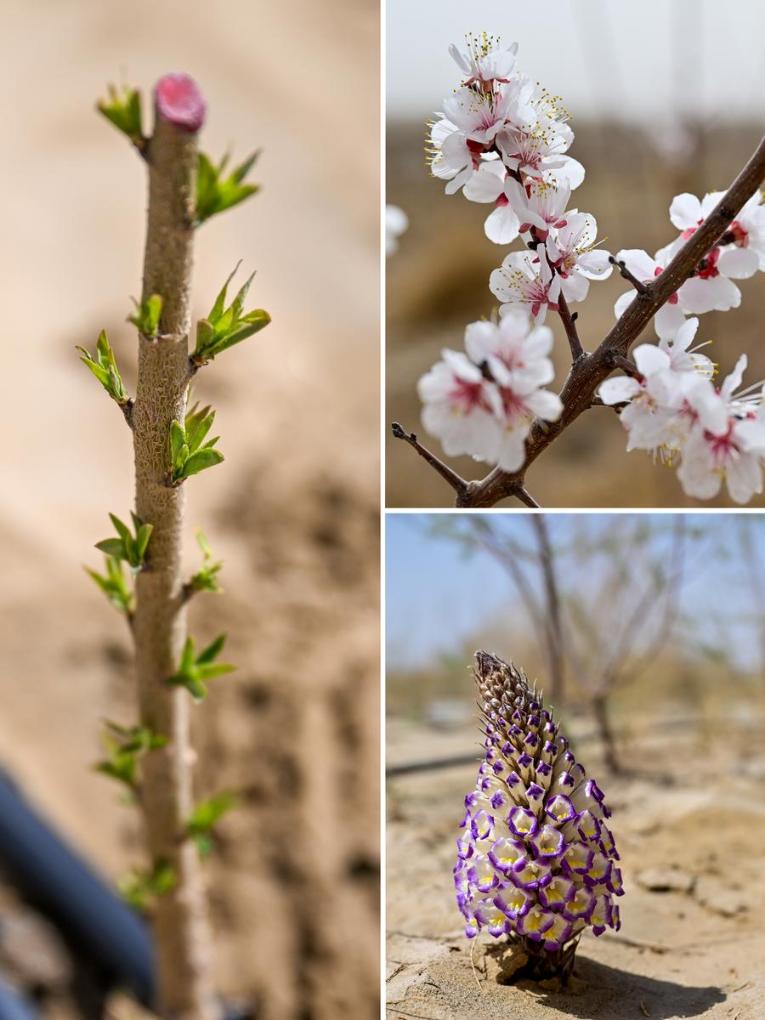
RISING SAND INDUSTRIES
Desertification control in Xinjiang has transitioned into a sustainable economic model, where ecological restoration initiatives have catalyzed industries including rose farming, cistanche cultivation and eco-tourism, forming a "golden necklace" of prosperity.
In Yutian, expansive rose fields bordering Highway G315 supply high-value ingredients for cosmetics and pharmaceutical products. Concurrently, the county produces 80 percent of China's cistanche output, generating employment for over 10,000 local residents.
Enterprises such as Xinjiang Silu Guobao Agriculture Co. have invested in desert areas, leveraging improved infrastructure and supportive government policies, and cultivate roses and pistachios on reclaimed land.
Alimjan Abdueni, the company's deputy general manager, emphasized that public-private partnerships allow land rentals to benefit villagers, fostering shared wealth.
Across the region, sand-based industries have expanded to 10.8 million mu of desert land, generating 28.975 billion yuan (approximately 4.1 billion U.S. dollars) in annual output value and engaging over 360 processing enterprises.

In Makit County, a 460,000-mu shelterbelt integrates ecological conservation with economic forestry, where rangers like Nurgul Aihait earn a stable income of 3,000 yuan monthly plus dividends from cistanche sales.
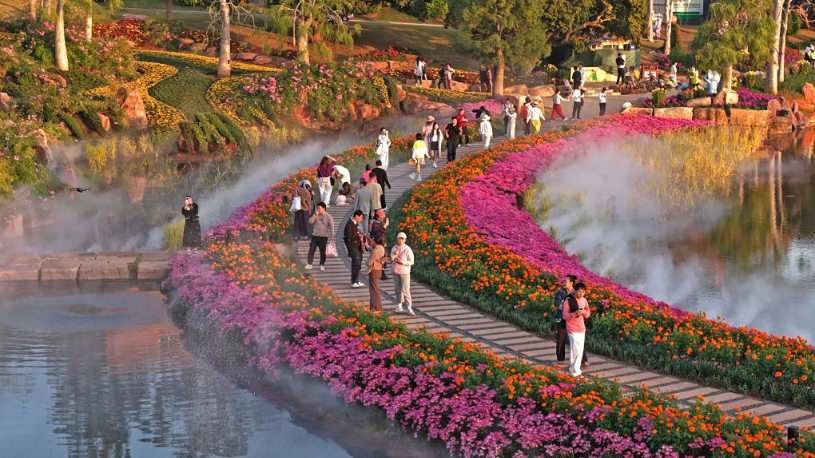
Tourism has emerged as a key growth sector, with attractions such as the Shaya Poplar Forest and Yuli Lop Nur Village attracting over 15 million visitors annually, generating 912 million yuan in revenue.
By 2025, the sand industry's expansion had boosted the average annual incomes of 300,000 farmers and herders by 3,000 to 4,500 yuan, creating a virtuous cycle where ecological restoration fuels economic prosperity.
"I think the case study can be transferred to another. But what we need to do is to consider the local conditions. So transfer this model, apply it, but adopt it to the local conditions," Mohamed Elfleet, consultant researcher at King Abdulaziz University (KAU) in Saudi Arabia, said.
(Video reporter: Su Chuanyi; video editors: Zhao Tianlin, Roger Lott, Hui Peipei) ■










Comments