Xinhua Headlines: China's historic National Games highlights regional collaboration in Greater Bay Area

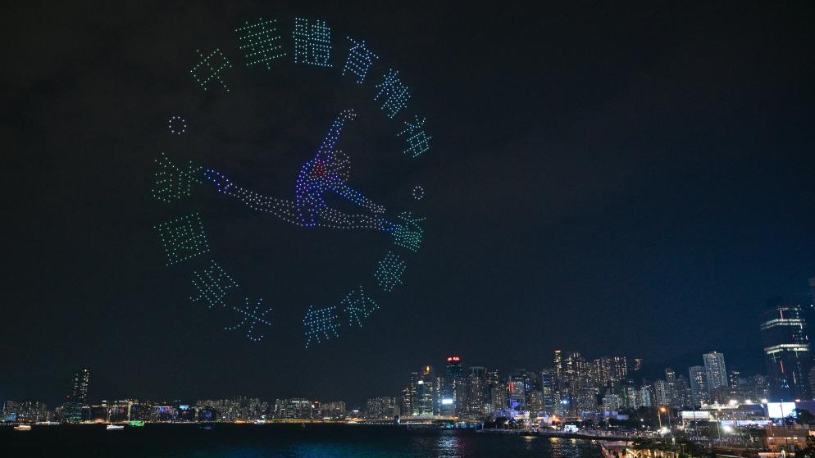
* For the first time in its 66-year history, China's National Games expanded beyond the mainland, with Guangdong, Hong Kong and Macao jointly hosting a multi-city celebration of sport that also served as a new platform for regional integration.
* The co-hosting highlights a shared identity rooted in Lingnan culture, with common language, Cantonese, and similar culinary traditions helping bind Guangdong, Hong Kong and Macao.
* Long before the National Games, the Greater Bay Area has been building a dense web of transport links, standards and policies that underpin closer economic and social integration.
by sportswriters Dong Yixing and Wang Haoming
GUANGZHOU, Nov. 21 (Xinhua) -- As sprint legend Su Bingtian ran his final race in front of a home crowd, the end of his career coincided with a historic new chapter for China's National Games.
For the first time in its 66-year history, the nation's premier multi-sport event expanded beyond the mainland, with Guangdong, Hong Kong and Macao jointly hosting a multi-city celebration of sport that also served as a new platform for regional integration.
The 15th Games, which closed in Shenzhen on Friday, featured 419 gold medal events for elite athletes and 166 for amateurs. Beyond the medal table, it marked a significant step in regional collaboration in the Greater Bay Area through a shared passion for sport.

"The National Games, with 25,000 athletes across so many age groups, is unique and creates a great sense of unity. China is a real powerhouse in international sport," International Olympic Committee (IOC) President Kirsty Coventry said after attending the opening ceremony in Guangzhou on Nov. 9.
A TAPESTRY OF DREAMS
The Games brought together emotional farewells, long-awaited breakthroughs and the emergence of a new generation.
For some legendary athletes, the National Games signaled the closing chapter of illustrious careers. Though Su and his young teammates finished fourth in the men's 4x100m relay, the 36-year-old 100m Asian record holder was met with a thunderous ovation.
"I won't leave the track that I love, and I hope to help more young Chinese sprinters reach the international stage," he said.
Other farewells came with titles. In badminton, the pair of Zheng Siwei and Huang Yaqiong clinched the mixed doubles gold for Zhejiang with a 2-0 victory, bringing a decorated partnership toward its conclusion.

Table tennis star Ma Long, at his sixth National Games, finally secured the team gold for Beijing. Olympic champion Gong Lijiao took a fifth consecutive National Games title in women's shot put, describing it as a fitting close to her 25 years in the event.
For several established names, the Games provided a long-sought breakthrough. Tennis player Zhu Lin, 31, won the women's singles gold on her fourth attempt, happily "changing the color" of her previous bronze. Wu Yibing also claimed his first singles gold at the National Games.
A strong group of young athletes underlined the depth of China's next generation. In the pool, 18-year-old Zhang Zhanshuo collected four individual freestyle golds in the 200m, 400m, 800m and 1,500m, along with a relay title. 13-year-old Yu Zidi broke the Asian record in the women's 200m individual medley and added the 400m IM gold.
On the track, new champions were crowned in the blue-riband sprints. Li Zeyang won the men's 100m in 10.11 seconds, while 16-year-old Chen Yujie took the women's 100m in 11.10 seconds, setting a new Asian junior record.

A BLUEPRINT FOR INTEGRATION
The 15th National Games is the first major sporting event co-hosted by Guangdong, Hong Kong and Macao. "It's a special mission entrusted to the Greater Bay Area by history," said Tong Lixin, deputy director of China's General Administration of Sport.
That mission translated into a detailed operational plan, with several high-profile sports allocated to Hong Kong and Macao. Hong Kong staged competitions in eight sports, including track cycling, fencing and rugby sevens, while Macao hosted four sports, with leading table tennis players and women's volleyball teams drawing full houses at major venues.
"Table tennis is our national sport, and also an approach to connect all Chinese people together," said Zhu Yuling, who retired from national team in 2021 and now represents Macao, China in international tournaments. "The Games is beyond the court, demonstrating enthusiasm and solidarity."
The connection was underlined by the 231.8-kilometer men's road cycling race, the first cross-boundary competition in National Games history. Riders crossed the three jurisdictions' checkpoints six times on the Hong Kong-Zhuhai-Macao Bridge without stopping, enabled by a seamless customs clearance system.

The Games' first cross-boundary marathon linked Shenzhen and Hong Kong, attracting 71 athletes including five from Hong Kong and one from Macao.
"When I was a child, coming to Shenzhen with my parents meant waiting in long queues, but now we can simply pass through with facial recognition," said Hong Kong female marathon runner Shiu Yan Leanne Szeto after completing the race. "I hope such marathons can continue to be held."
"Cross-boundary events not only showcase the collaborative capacity of the Greater Bay Area cities, but also foster a closer connection among the people," said Chan Kwok-ki, chief secretary for administration of the Hong Kong SAR government.
A BRIDGE BETWEEN ERAS
The co-hosting of the National Games highlights a shared identity rooted in Lingnan culture. Common language, Cantonese, and similar culinary traditions help bind Guangdong, Hong Kong and Macao, despite their different modern histories and administrative systems.

The four-city torch relay offered a vivid illustration of this shared heritage. On Nov. 2, the relay started simultaneously in Shenzhen, Hong Kong, Macao and Guangzhou, marking the first cross-boundary torch relay in National Games history and the first time the flame had been carried in Hong Kong and Macao.
Technology also played a visible role. In Shenzhen, "Kuafu," described as the world's first 5G-A humanoid robot, independently completed part of the relay. In Guangzhou, an autonomous vehicle transported the flame lantern through the city.
The opening ceremony brought tradition and innovation together under the theme "Shared Roots, Shared Heart, Shared Dream." Lingnan cultural symbols such as lion dancing, Cantonese opera and dragon boat racing were presented alongside artificial intelligence, virtual reality elements and robotic performances.
"We are pursuing not just a magnificent performance, but an experience where everyone can feel the warmth of sport, the affinity of culture and a sense of belonging to the Greater Bay Area family," said Andrew Lau Wai-Keung, chief producer for the opening ceremony.

A FOUNDATION OF CONNECTIVITY
Long before the National Games, the Greater Bay Area has been building a dense web of transport links, standards and policies that underpin closer economic and social integration.
Large-scale infrastructure has shortened distances across the region. Six cross-river and cross-sea passages are now in operation, including the Hong Kong-Zhuhai-Macao Bridge, which opened in 2018 and cut the journey between Hong Kong and Zhuhai or Macao from three hours to about 45 minutes.
By October this year, the bridge had handled a total of more than 93.34 million passengers and 19.42 million vehicles. Annual vehicle trips have risen from 860,000 in 2019 to 5.46 million so far in 2025, with officials at the border inspection station forecasting more than 30 million passengers and six million vehicles for the year.
The region's connectivity supports a major economic cluster. In 2024, the Greater Bay Area's gross domestic product reached 14.79 trillion yuan (about 2.08 trillion U.S. dollars), exceeding that of the New York and San Francisco Bay Areas.

Alongside physical linkages, a set of common standards is gradually taking shape. Some 235 Bay Area Standards have been issued in fields such as food, transport and services, with more than 6,800 institutions applying them.
In Zhuhai, 545 types of Macao-registered medicines are now available in one clinic, where Macao health insurance can be settled directly. More than 90 institutions have adopted jointly developed standards for childcare and dementia care.
Integration is also reflected in youth and business exchanges. In Guangzhou's Nansha district, 15 youth innovation and entrepreneurship bases have incubated 1,178 projects from Hong Kong and Macao. In Shenzhen's Qianhai cooperation zone, the number of Hong Kong-funded enterprises almost doubled in the first half of 2025, supported by a package of favorable policies.
"Across the Greater Bay Area, we integrate technological, market and industrial resources," said Chen Fu-rong, dean of the City University of Hong Kong's Matter Research Institute in Shenzhen's Futian district. "Its synergy is gradually taking shape."
(Video reporters: Wang Ruiping, Lu Xingji, Gao Shang, Zhang Wuyue, Yu Lizhen, Liang Jiajun and Xie Niu; video editors: Zhang Yucheng, Roger Lott and Hui Peipei) ■






Comments