




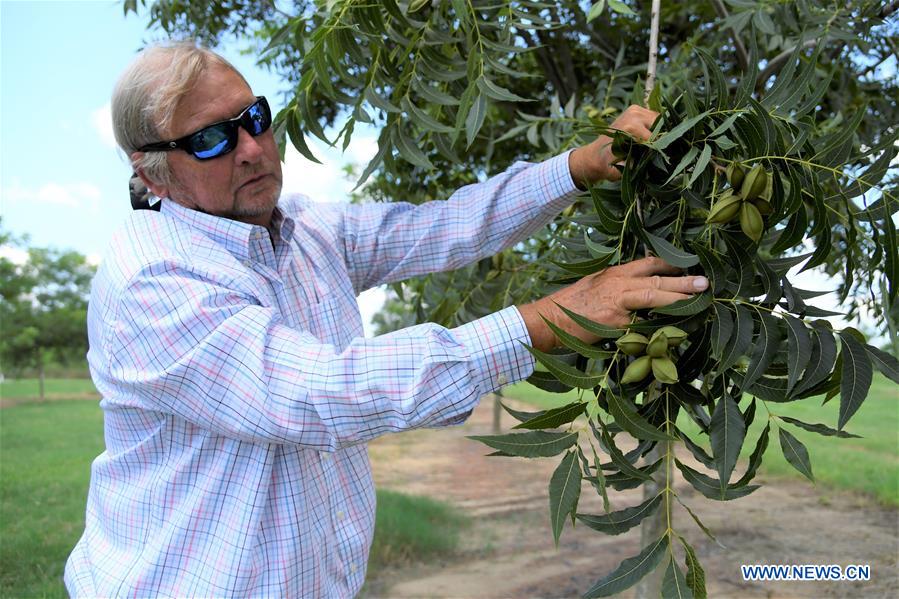
Randy Hudson shows a bunch of pecan on his farm in the State of Georgia, the United States, on July 10, 2018. (Xinhua/Yang Chenglin)
by Xinhua writers Gao Pan, Liu Yang, Liu Chen
WASHINGTON, July 23 (Xinhua) -- Farmers and businesses across the United States have begun to feel the pain, as its major trading partners, including China, Canada, Mexico and the European Union (EU), retaliate against a wide range of American products, in response to Washington's ill-advised tariffs.
Under the "America First" protectionist policies, the Trump administration has slapped high tariffs on imported steel and aluminum, as well as 34 billion U.S. dollars of Chinese products, escalating trade tensions with its major trading partners.
For the United States, "that's not a good strategy. There'll be enough pushback from U.S. manufacturers, who will actually be harmed by these strategies," said Dennis Chookaszian, an adjunct professor at the University of Chicago Booth School of Business.
It's not clear how these trade disputes will end, but American farmers and businesses are going to pay a very high price. Here are several American products being affected by retaliatory measures from those trading partners.
DAIRY
The U.S. dairy industry, which has been increasingly dependent on foreign markets after years of shrinking domestic consumption, has been stung by the trade disputes provoked by Washington.
The Trump administration's new tariffs on many countries, including Mexico, Canada and China, which are major destinations for U.S. milk products, have prompted retaliatory actions.
According to the U.S. Chamber of Commerce, the Mexican tariffs could affect as much as 578 million dollars' U.S. dairy goods and China's tariffs could influence 408 million dollars' cheese, whey and other products.
"We are calculating that farmers may be losing between 1-2 billion dollars just in the next few months," Jaime Castaneda, senior vice president of the U.S. Dairy Export Council, told Xinhua.
"At this very moment, I don't think we're going to lose a lot of exports, but what we are going to lose are a lot of farmers," he said.
SOYBEANS
Don Lutz is getting more and more nervous after spraying soybean at his farm in Scandinavia, Wisconsin, as U.S. soybean futures have already fallen by nearly 20 percent since April.
"Things have escalated into different and broader areas ... It doesn't look like we're going to get these tariff issues resolved by the time you go to harvest," Lutz told Xinhua during a recent trip to Washington to voice his concern before lawmakers.
"To make things worse, most farms are heavily in debt," said Brad Kremer, a soybean farmer in Pittville, Wisconsin with about 3 million dollars worth of idle equipment. "I'm already looking at a loss this year."
"If somebody were to lose 20 percent of their income, that hurts," said Ryan Findlay, chief executive officer of the American Soybean Association (ASA).
"Farmers see that pain right now. They see that in the prices. That is the immediate impact," he said.
China is the top importer for U.S. soybeans, accounting for almost 14 billion dollars in sales, or nearly a third of total U.S. soybean production and two thirds of total U.S. exports, according to the ASA.
John Heisdorffer, president of the ASA and a soybean farmer in the state of Iowa, said last week that the U.S. threat to impose additional tariffs on China was "a move in the opposite direction."
"Our message to the administration and lawmakers remains the same: these tariffs needlessly hurt soy growers and rural communities," he said.
"I don't favor protectionism or tariffs as a way to negotiate a 'better trade deal'," Lutz echoed.
"From my perspective, tariffs on steel and aluminum and counter tariffs on agricultural commodities, is a lose-lose relationship for not only American agriculture, but both countries' overall economies," he said.
PECANS
On average, a third of all pecans grown in the United States are sold in China. For Randy Hudson, a farmer in the leading pecan producing state of Georgia, the amount is much more: practically all of his crop goes across the Pacific.
"I can tell you this, 99 percent of our production goes to China," said Hudson, who has gradually expanded his pecan farm acreage from a few hundred to 2,500 to meet the growing demand of pecans in China.
"I've just begun a project to expand my storage room and pecan processing power three-fold last year," Hudson told Xinhua.
However, China's retaliatory tariffs on U.S. pecans make Hudson's business vulnerable, as the 10-million-dollar project was financed by loans and is dependent on stable sales revenues.
Hudson estimated that 30-40 percent of his sales will evaporate, registering a loss of 6-8 million dollars, significantly higher than his profit margin. In addition, imported parts that are crucial to farming may also become more costly, further squeezing Hudson's margin.
"We're the collateral damage of a much bigger fight," Hudson said. "Mr. Trump understands the art of deal in North America... but I'm not sure he understands the art of deal in Asia and our good friends in China."
LOBSTERS
Tom Adams, owner of Maine Coast Company, sees a huge market potential for Maine lobsters in China, especially when its second-tier cities started to show a great appetite for seafood.
He is expanding the company's facilities and hoping to ship more to the world's fastest expanding lobster market. But the Trump administration's tariff scheme against China may well ruin his plan.
With China's retaliatory tariffs, the U.S. lobster industry will further lose its edge over its archrivals, such as Canada, Annie Tselikis, executive director of the Maine Lobster Dealers' Association, told Xinhua.
"That's frustrating for us because competing in a disadvantaged market will be challenging," she said.
China's tariff on Canadian lobsters dropped to 7 percent at the beginning of this month, while the tariff on U.S. lobsters has risen to 40 percent.
"The tariffs will impact almost everybody in Maine as people in the state are more or less involved in the industry," Tselikis said, noting that China accounts for 15-20 percent of the export value of U.S. lobsters.
The congressional delegation in Maine has warned that the trade conflict with China would jeopardize the state's lobster industry.
"To save our state's economy from further hardship and uncertainty, I urge the administration to pursue a more coherent and methodical trade strategy and to weigh the potential repercussions carefully before taking further action," said Congresswoman Chellie Pingree.
WHISKEY
To meet the booming demand for American whiskey, particularly from Europe and Asia, distilleries that make Bourbon have mushroomed in recent years.
Amir Peay is one of those distillers lured into the industry, investing several millions of dollars to refurbish an evolutionary war-era whiskey brand in Lexington, the state of Kentucky.
However, retaliatory tariffs from the EU and China on American whiskey have pushed up the prices of the signature U.S. liquor and cast a shadow over Peay's promising business.
While the uniqueness of U.S. whiskey has won loyal consumers who are willing to pay the extra money, higher prices could very well "put the brakes" on a promising growth momentum the industry is seeing, Peay told Xinhua.
"Basically the whole world put a 25 percent tariff on our industry, where we are collateral damage in this, it's very disappointing," he said.
Peay said bigger names in the industry can store their inventory for a possibly better time in the future, but his small distillery is more vulnerable in any disruptive trade environment.
Eric Gregory, president of Kentucky Distiller's Association, told Xinhua that he hoped Washington and Beijing would solve their disputes through negotiations, as there are no winners in a trade war.
"We would just like to see everybody sit down. If they need to sit down over a glass of Bourbon and work this out, we'll provide the whiskey," he said.
(Xinhua reporters Wang Wen, Yang Shilong, Zhang Mocheng, Hu Yousong, Guo Yina contributed to this report.)
(Video editors: Luo Hui, Cao Ying)