




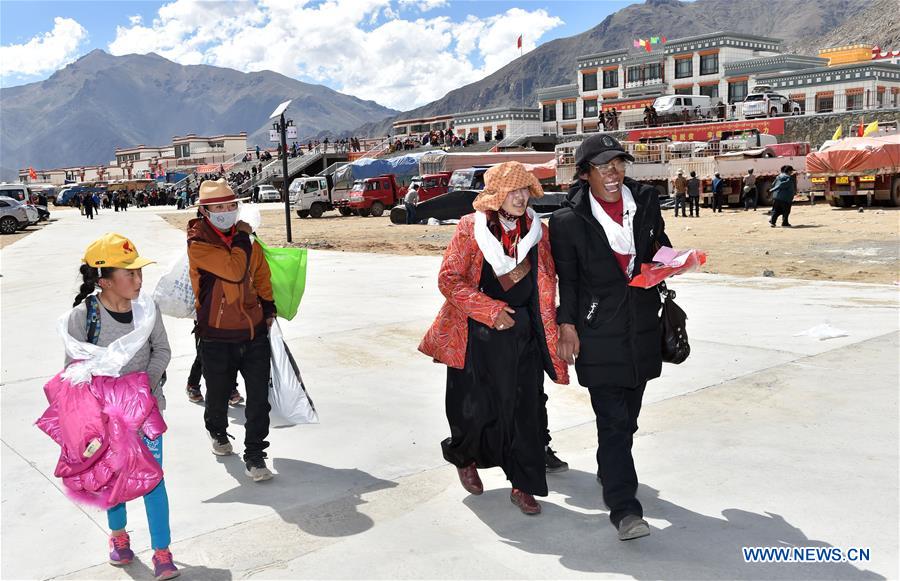
Rigzin (1st R) and his family arrive at Katrug Village, their new home in Lhasa, southwest China's Tibet Autonomous Region, June 18, 2018. (TO GO WITH Xinhua Headlines: Relocation changing lives on Tibetan plateau) (Xinhua/Chogo)
by Xinhua writers Cao Bin, Cheng Lu, Zhang Jingpin
LHASA, June 20 (Xinhua) -- Wearing red lambskin clothing and a fur hat, Rigzin cracked a herding whip to drive his sheep home. In front of his house, he took a photo with the livestock, for perhaps the last time on the prairie where he has lived for more than 40 years.
Due to an ecological relocation program in high-altitude areas of Tibet Autonomous Region, Rigzin, his wife Karma Detso and son have decided to leave their hometown in Rungma Township, Nagqu for Lhasa, the regional capital, to start a new life.
"I've been herding sheep and cattle for more than 40 years, and I thought my whole life would be just like this," said Rigzin, 49, who had often wondered if he could ever leave one of the most inhospitable places on earth.
TO STAY OR LEAVE
A small television and a ghee making machine are the only electric appliances in Rigzin's adobe house which stands against a snow-dusted landscape.
Every day, the family made four trips to carry water from a nearby river. In winter when the river was frozen, they had to trek further to collect water.
Rigzin rode his motorbike across the prairie to the township seat, around 30 km away, to make a phone call or send a WeChat message.
Life in Rungma is anything but modern. Endemic diseases such as rheumatism and heart disease are prevalent. White-haired elderly residents are rare, because the life expectancy is no more than 60 years, much lower than the region's average.
Harsh natural conditions have also precluded any possibility of improving the standard of living of residents. Storms and heavy snow seal the mountain passes every winter.
Due to its remoteness, basic public services including education and medical care are not always accessible. The local primary school only offers education for students from Grade 1 to 3 and only four students from the township have been admitted to university over the past five years.
"One of our colleagues once joked that this area is not suitable for humans and should be left to wild animals," said Jamyang Paljor, secretary of the township's Party committee.
In April 2017, the regional government decided to launch an ecological relocation program in high-altitude areas. Rungma was the first on the list.
Relocation is not compulsory. There are a total of 1,102 residents in 262 households in Rungma. Among them 81 are registered low-income households.
Last June, a form was sent to Rigzin's home, seeking opinions on relocation. He was excited to have a chance to live in Lhasa a place he had visited three times.
But many concerns soon dampened his excitement. How would he deal with his sheep and what would he do in Lhasa? So he refused.
More than 200 families like Rigzin's initially refused the offer of relocation. Township officials went door to door to explain the favorable relocation policies, including new homes, better education for children, medical care for the elderly, and assured residents their livestock would be taken care of.
Rigzin swayed toward relocation after officials visited him the second time. After a family discussion, he placed his red fingerprint on the form to show agreement the next day.
RETURNING LAND TO WILDLIFE
About 50 km north to Rungma, workers have begun dismantling pasture fences that Dradul spent a fortune to build. The 600-hectare meadow he fenced in is in the core area of the Qiangtang National Nature Reserve, an important habitat for Tibetan antelopes.
"Antelopes used to get injured on the fences," said Dechen Lhundrup, deputy head of forestry police in Nyima County.
Before Dradul relocated to Lhasa, he called the forestry police to help him dismantle the fences.
"The meadow used to belong to wild animals. Now we are leaving, and it's time to return the land to its original owners," Dradul said.
Rungma is located in the state-level reserve. At an average altitude of more than 5,000 meters, the reserve covers 298,000 square km and is home to dozens of protected species.
Due to the relocation program, about 180,000 hectares of meadow will be left undisturbed by grazing activities. The local government will gradually dismantle all the fences.
A total of 570 people have relocated to new homes in Lhasa. Rigzin's daughter and son-in-law stayed to look after the remaining flocks. They can also entrust the animals to cooperatives when they decide to move to Lhasa and continue to earn revenue from their animals.
According to the regional government, 27,880 residents from 6,910 households will be relocated in the five years from 2016 to 2020. Nearly 10,000 people will be able to move into their new homes by the end of this year.
MOVING FOR A BETTER FUTURE
After two days of walking, bus and truck journeys across mountain passes and grasslands, Rigzin's family arrived in Lhasa on Monday afternoon.
Katrug Village, their new home 3,800 meters above sea level, has been built with a total investment of over 200 million yuan (31 million U.S. dollars). In addition to 266 homes, a kindergarten, villagers committee office building, and other infrastructure are already in operation.
Relocation is more cost-effective than staying. In comparison, building an asphalt road to Rungma alone would cost at least 800 million yuan.
Each family is allocated a home of 80 to 180 square meters based on the number of family members. The steel-framed construction can resist earthquakes up to 8 magnitude.
The relocated families should pay 10 percent of the construction cost per family member, approximately 6,000 yuan per person. Registered poor households are exempt for this.
Not far from where they live, a 33-hectare industrial park is taking shape. Wang Guochen, deputy mayor of Lhasa, said 220 jobs have been created, and more to come to guarantee at least one job for each household.
Rigzin's new house covers 150 square meters. As night approached, he put away his luggage and boiled a pot of water with gas cooker to take a foot bath.
He will take his son to a nearby primary school in the morning. His wife is expected to give birth very soon. The couple have lost six children due to harsh natural environment and poor medical conditions.
"I will give the baby a good name to commemorate this life-changing trip. With better medical resources, we believe that he or she will be healthy and safe this time," he said.
(Video editors: Shan Ruchao, Xu Yalan)